
? TL;DR — MicroXRF Is Redefining Battery Research
A new collaboration between the Université du Québec à Montréal and IXRF Systems shows that high-spatial-resolution benchtop microXRF can monitor electrolyte salt concentration gradients in lithium-ion batteries during operando, a task that was previously limited to costly, scarce synchrotron facilities.
Using a 5 µm beam, the team achieved resolution comparable to synchrotron methods, revealing how salt gradients change during charge and discharge cycles. The lower photon flux reduced beam damage and made long-duration measurements possible.
This breakthrough democratizes access to advanced chemical imaging, opening the door to wider research in:
- Lithium redistribution tracking
- Transition metal migration
- Interface degradation and failure analysis
- Real-time operando studies at high C-rates
As the next generation of batteries requires a deeper understanding of internal electrochemistry, microXRF offers a powerful, accessible option, enabling researchers and manufacturers to innovate more quickly and effectively.
Introduction
A breakthrough collaboration between IXRF Systems and McGill University demonstrates how accessible, high-resolution microXRF can accelerate next-generation battery innovation.
When scientists want to understand how batteries behave under stress, they need to look inside the cell without disturbing it. Historically, this required a trip to a synchrotron, a scarce, expensive, and logistically difficult resource. That’s now changing.
In a new study published in ACS Applied Electrochemistry, researchers from the Université du Québec à Montréal and IXRF Systems have shown that high spatial-resolution benchtop microXRF can deliver insights once thought to require a synchrotron. This breakthrough could mark a turning point in how the world studies and improves advanced batteries.
The Challenge: Understanding Electrolyte Salt Gradients
One of the silent performance killers in lithium-ion batteries is the formation of electrolyte salt concentration gradients during fast charging and discharging. As current flows, ions become unevenly distributed inside the cell. These gradients decrease power output, speed up degradation, and reduce battery lifespan.
Until now, studying these gradients at the appropriate spatial and temporal resolutions has been limited to specialized facilities. Techniques like Raman or NMR provide valuable information but struggle to penetrate porous electrodes, where the most critical phenomena occur. Synchrotron XRF offers deeper insight but requires precious beam time and can damage sensitive materials.
This is where laboratory microXRF comes into play.
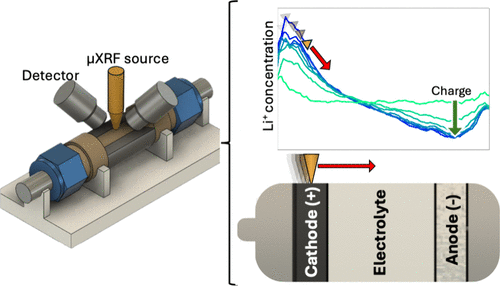
Figure 1. Visualizing electrolyte behavior inside a battery in real time. A benchtop microXRF system uses a focused X-ray beam and dual detectors to scan the battery cell without disassembling it. The resulting concentration profile (right) reveals how lithium ions shift during charging, with higher concentrations near the cathode and depletion near the anode. This powerful technique gives researchers a clear, non-destructive view inside working batteries, helping to understand and improve performance.
The Breakthrough: High Spatial Resolution on the Benchtop
In this study, researchers used a custom-designed Swagelok cell and IXRF’s high spatial resolution microXRF system to monitor electrolyte salt distributions during charge–discharge cycles in real time. By using arsenic as a proxy signal for lithium ions, they generated operando concentration maps at multiple current densities.
The results were striking.
- The 5 µm beam size achieved spatial resolution comparable to synchrotron experiments.
- Heatmaps captured evolving gradients at different states of charge and rest periods.
- Lower photon flux reduced beam damage, enabling extended cycling measurements.
- Data quality and spatial fidelity were consistent with previous synchrotron-based studies
In short, the team proved that what once required a national facility can now be accomplished in a laboratory.

Figure 2. Seeing batteries in action—without taking them apart. Using operando microXRF, researchers can monitor elemental changes inside a lithium-ion battery in real time. The heatmap (top) tracks X-ray emission from key elements during cycling, while the voltage curve (bottom) shows how the cell responds. Together, these data reveal how ions move and concentrate during charging and discharging—critical insights for designing longer-lasting, higher-performance batteries.
Why This Matters
The implications extend well beyond a single experiment. MicroXRF’s unique capabilities, deep penetration, minimal sample preparation, and real-time multi-element mapping make it a valuable tool for battery researchers and manufacturers alike.
Where microXRF excels:
- Probing buried interfaces without disrupting electrochemistry.
- Mapping critical gradients that other techniques miss.
- Monitoring long-duration cycles without synchrotron beam damage.
- Visualizing multiple elements simultaneously, from salts to additives.
This versatility makes microXRF especially valuable in emerging areas of battery R&D:
- Lithium inventory mapping and tracking redistribution
- Transition metal dissolution and migration studies
- Cathode–electrolyte interphase formation
- Binder and conductive additive distribution analysis
- Post-mortem failure diagnostics
A New Model for Research Access
Synchrotrons will always play a role in cutting-edge materials science. But democratizing access to operando high-resolution chemical imaging changes the equation. Laboratories, universities, and companies can now perform critical battery investigations without waiting months for beam time or shipping sensitive cells across the globe.
“This research demonstrates that benchtop microXRF can provide synchrotron-level insight with far fewer barriers,” said an IXRF Systems spokesperson. “This is about making powerful science more accessible.”

Figure 3. An in-operando battery cell is positioned inside the Atlas microXRF instrument for real-time measurements. A custom-modified Swagelok-type cell is mounted on the Atlas microXRF system’s sample stage. Electrical leads are connected to enable simultaneous electrochemical cycling while the X-ray source and detectors (top) acquire spatially resolved fluorescence data. This configuration allows operando monitoring of electrolyte and electrode chemistry without disassembling the cell.
The Future: Next-Generation Batteries Demand Next-Generation Tools
As the race to develop faster, more durable, and more energy-dense batteries accelerates, the demand for better diagnostic tools will only grow. Technologies like IXRF’s Atlas Apex microXRF systems, capable of high spatial resolution, extended measurement durations, and flexible sample environments, will be essential to unlocking the performance of next-generation batteries.
Tomorrow’s battery breakthroughs won’t happen in isolation—they’ll be built on the ability to see and understand what’s happening inside the cell in real time.
And that’s exactly what this collaboration delivers.
About the Study
This research was conducted by:
- Université du Québec à Montréal (NanoQAM Center)
- McGill University, Department of Chemistry
- IXRF Systems, Austin, Texas
Bastian Krueger, Brittany Pelletier-Villeneuve, Jonathan Adsetts, Marie-Claude Ricard, Ben Ruchte, Steen B. Schougaard, et al. “Measuring Electrolyte Salt Concentration Gradients in Lithium-Ion Batteries Using Benchtop μ-XRF.” ACS Applied Electrochemistry (2025).
DOI: 10.1021/acselectrochem.5c00055.
Looking Forward
This collaboration represents more than a technical achievement. It’s a paradigm shift in how we conduct advanced materials research, faster, more accessible, and more powerful than ever before.
IXRF Systems is proud to have contributed to this work and remains committed to enabling the battery research community with advanced microXRF technology.