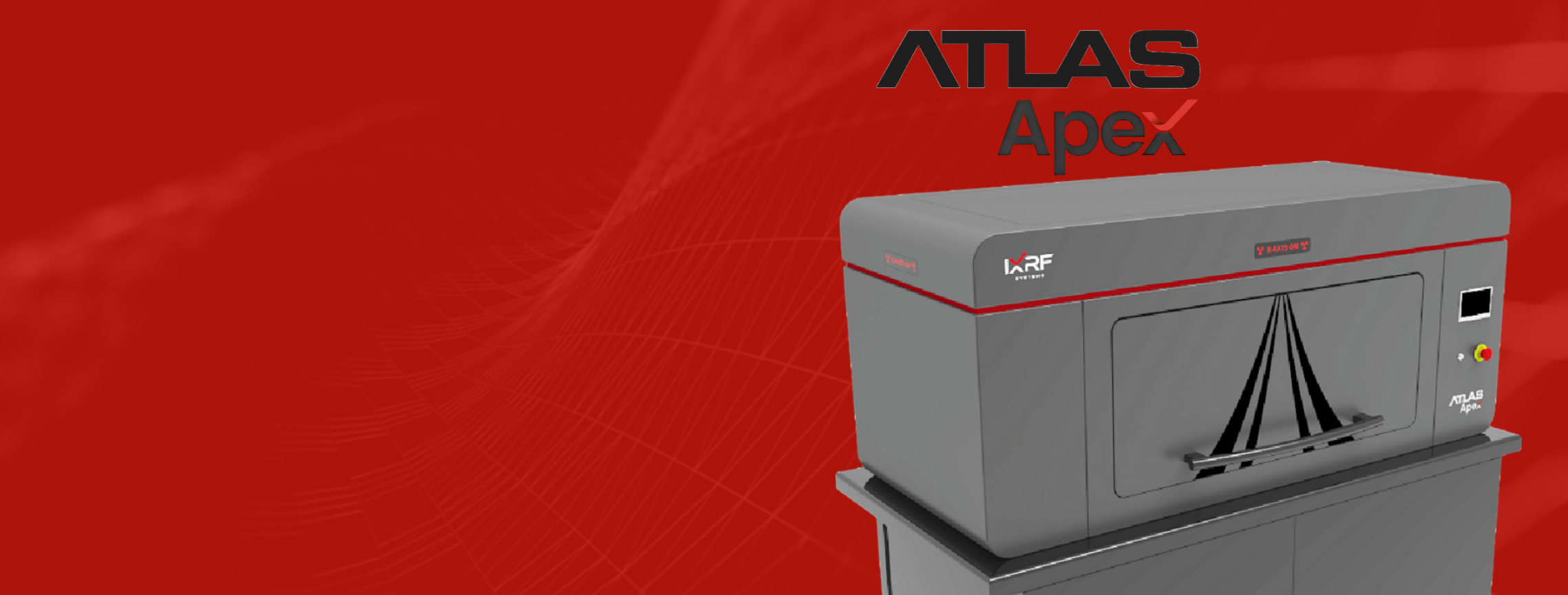

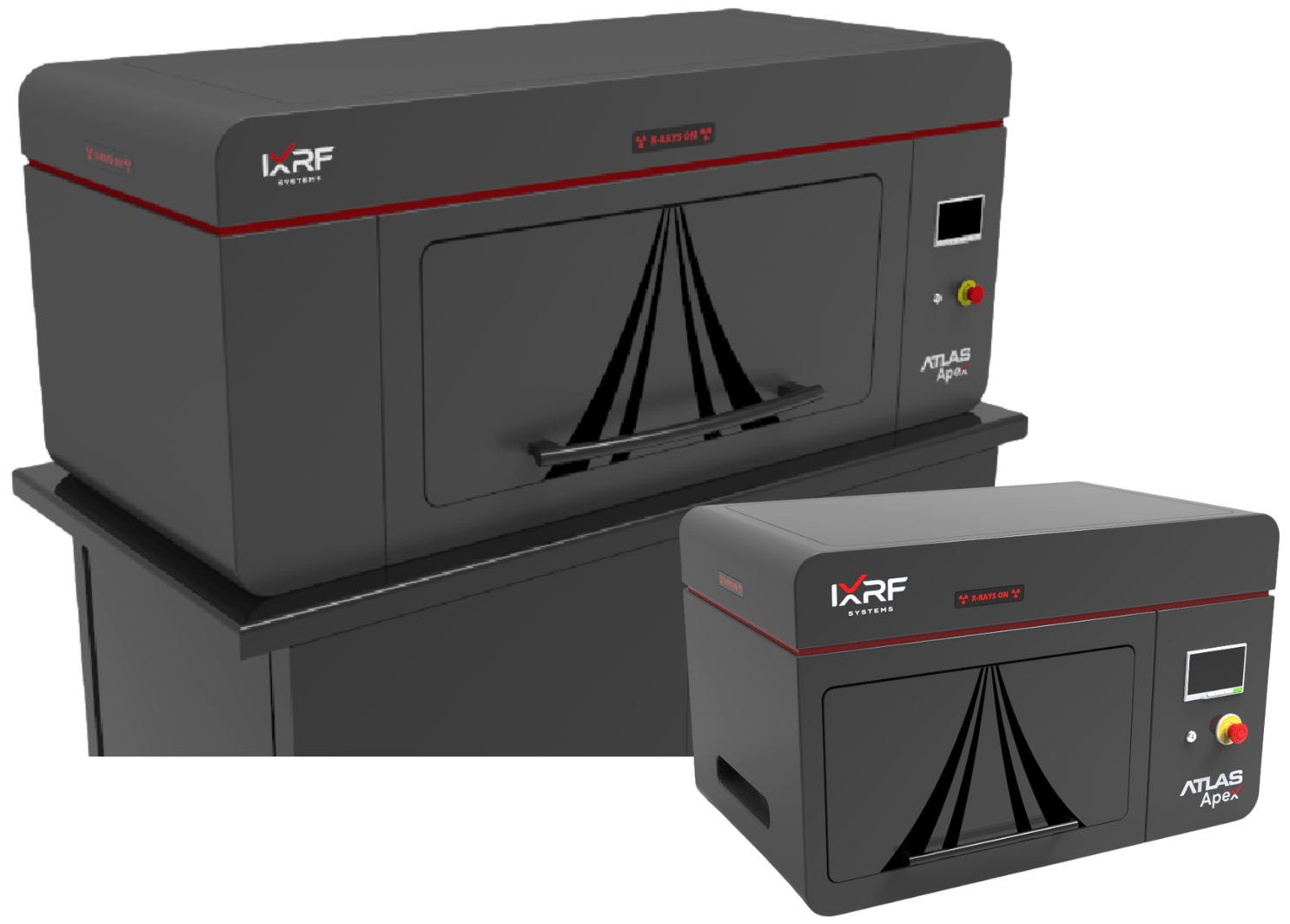
ATLAS Apex M Benchtop microXRF Micro-spot Energy Dispersive
X-ray Fluorescence Spectrometry
ATLAS X microXRF Ultimate Micro-spot Hyperspectral
XRF Imaging Spectrometer System

∙ Up to 280 mm² SDD for fast maps

∙ 5 um spot size for highest spatial resolution

∙ Largest chamber with 300 x 400 mm mapping

∙ Perpendicular tube geometry for round pixels


∙ Easy-to-use Iridium Ultra software w/ automation

SEM/EDS | SEM/EDX Energy Dispersive X-ray
Fluorescence Spectrometry
for Electron Microscopy
New Systems & Upgrades
SEM-XRF Integrated e-Beam / X-ray Beam X-ray Sources for
Electron Microscopy

Our Products

IXRF provides advanced microXRF technology for geoscience and critical minerals, semiconductor and electronics analysis, battery and energy materials, environmental and agricultural research, and cultural heritage studies, led by the Atlas Apex platform.
The Atlas Apex microXRF spectrometer delivers high-resolution elemental mapping and hyperspectral imaging from carbon (C) through uranium (U), enabling rapid, non-destructive analysis of ores, electronic components, battery chemistries, soils, and historical artifacts.
IXRF further enhances analytical performance with integrated SEM/EDS and SEM-XRF solutions, extending elemental detection and enabling deeper insight into complex materials across research, quality control, and industrial applications.
Specializing in: microXRF (Atlas Apex) • SEM-XRF • SEM/EDS
Made in U.S.A.

micro-XRF

Imaging microXRF Spectrometers

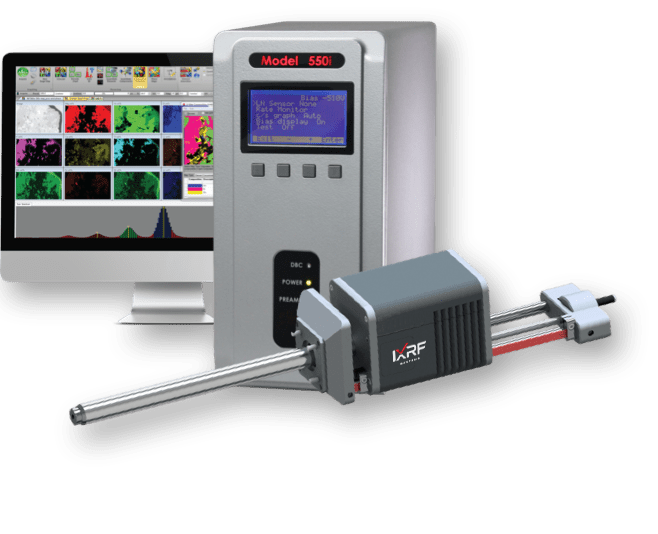
The ATLAS Apex series of micro-XRF microscopic hyperspectral imaging spectrometers are the latest general purpose micro X-ray spot energy dispersive X-ray fluorescence (EDXRF) instruments for the measurement and mapping of elements from carbon (C) through uranium (U).

Designed to image and analyze a wide variety of sample types, ATLAS Apex leads the industry in virtually every major specification category, from the most powerful software  (Iridium Ultra) and the largest detector active area, to our superior perpendicular geometry and smallest micro-spot.

Microanalysis

SEM/EDS — SEM-XRF — SDD

SEM/EDS:  For scanning electron microscopes (SEM), we offer a complete EDS (EDX) system: software,  SDD detectors, digital signal processor and software. Our Windows®-10 based EDS software – Iridium Ultra – delivers all-inclusive  functionality.

SEM-XRF:  IXRF’s Xb micro-spot X-ray source adds the capabilities of a complete micro X-ray fluorescence (microXRF) spectrometer to any scanning electron microscope (SEM). μXRF users benefit from non-destructive measurements, superior trace element sensitivity and broader elemental coverage (Na through U) .

Recent Articles

Seeing the Invisible—On Earth and Beyond: How MicroXRF is Rewriting Volcanic and Planetary Narratives

| Articles | No Comments
⚡TL; DR — High-resolution microXRF mapping with the Atlas Apex M reveals that lava is not chemically uniform but spatially structured—capturing flow dynamics, elemental segregation, and post-emplacement alteration. This transforms…

MicroXRF vs SEM-EDS for Geological and Petrological Analysis: Why Sensitivity and Scale Matter

| Articles | No Comments
⚡TL; DR — SEM and EDS are powerful tools for high-resolution imaging and micro-scale chemistry, but they are not designed to map large areas or detect low-level trace elements across…

MicroXRF Throughput vs Data Quality: How to Prevent Spectral Distortion at High Count Rates

| Articles | No Comments
⚡TL; DR — In microXRF, “faster” only creates value if spectral integrity holds at elevated count rates. Many systems degrade as throughput rises—broadening peaks, increasing overlaps, and reducing counting statistics—creating…

Advancing Aerospace Materials Confidence with MicroXRF

| Articles | No Comments
⚡ TL;DR Summary The Atlas Apex MicroXRF gives aerospace organizations high-resolution, non-destructive elemental analysis that significantly improves materials confidence. It enables engineers to verify complex alloys, coatings, and additive-manufactured parts…

Why High-Resolution MicroXRF Is Becoming Essential for Critical Mineral Strategy

| Articles | No Comments
⚡ TL;DR Traditional XRF core scanners cannot resolve the micron-scale mineral features that define the value, processing behavior, and strategic viability of critical mineral deposits. High-resolution microXRF systems like the…

How Operando MicroXRF Transforms Battery Research

| Articles | No Comments
🧪 TL;DR — MicroXRF Is Redefining Battery Research A new collaboration between the Université du Québec à Montréal and IXRF Systems shows that high-spatial-resolution benchtop microXRF can monitor electrolyte salt…
how it works?

View Our Videos

Demonstration of ProSA Steel Analyzer

ArcelorMittal Describes ProSA

EDS RoboStage

EDS Multi Part Acquire

EDS Export to Word

EDS Morphology

Scrolling Element Markers

Quant Spectrum Match

View Linescan Data

Stored Spectrum Extraction

Linescan Overlay

Annotations

Application Customization

Auto Quick Quant

Auto Peak I.D.

Compare Spectra

Custom Template & Report

Custom Settings

Energy Calibration

Estimate kV

Interactive Help

Linescan Extraction

Map Feature Demonstration

Map Intensity & Conc

Map Overlay

Max Pixel Spectrum

Peak Marker Adj

Threshold Maps

ATLAS M

IXRF Systems specializes in micro-spot X-ray fluorescence (XRF) spectrometers employing energy dispersive detectors (EDXRF). XRF is an X-ray spectrometric technique for elemental analysis of a wide variety of materials. Other phrases for XRF instruments include: microXRF, microEDXRF, micro-XRF, micro-EDXRF, μXRF, μEDXRF, micro XRF, energy dispersive X-ray spectrometry, energy dispersive spectrometry (EDS or EDX), X-ray spectroscopy, energy dispersive X-ray spectroscopy, XRF analyzer, XRF spectrometer, XRF analysis, X-ray fluorescence analyzer, x-ray fluorescence spectrometry, fluorescence x, spectromètre de fluorescence X, Röntgenfluoreszenzanalyse, fluorescencia de rayos X, Röntgenfluoreszenz, Röntgenfluorescentie, Röntgenfluorescens, Röntgenfluoresenssi, Røntgenfluorescens and Promieniowanie rentgenowskie.

need training? We got it

Join Us for Training in Austin, TX or From Anywhere in the World

Request Training
HAVE QUESTIONS?

FAQs

How is microXRF different from conventual XRF?

Conventional XRF provides bulk elemental analysis over millimeter- to centimeter-scale areas. MicroXRF uses focused beams to resolve elemental distributions at the micron scale, enabling detailed analysis of elemental zoning, inclusions, phase boundaries, and layered structures that bulk XRF cannot resolve.

How does microXRF compare to SEM-EDS?

MicroXRF offers greater analysis depth, improved trace-element sensitivity, and no vacuum requirement, making it well-suited for large, thick, or non-conductive samples. SEM-EDS provides higher surface spatial resolution but is limited to near-surface analysis and often requires conductive coatings.

What spatial resolution can Atlas Apex achieve?

Depending on configuration, the Atlas Apex microXRF system achieves spot sizes down to ~5 µm, enabling detailed micro-XRF elemental mapping of fine features such as grain boundaries, inclusions, reaction fronts, and compositional gradients.

What elements can be detected with microXRF?

Atlas Apex supports elemental detection from light elements through heavy elements, depending on the detector and window configuration. This broad elemental range supports applications in critical minerals, geology, metals and alloys, ceramics, composites, and environmental materials.

How fast is elemental mapping with microXRF?

MicroXRF mapping speed depends on resolution and mapped area, but Atlas Apex is optimized for high-throughput elemental mapping using high-flux X-ray sources, efficient optics, and advanced digital pulse-processing electronics.

Social Media