
⚡ TL;DR
Traditional XRF core scanners cannot resolve the micron-scale mineral features that define the value, processing behavior, and strategic viability of critical mineral deposits. High-resolution microXRF systems like the Atlas Apex X deliver 5–10 µm imaging, low-Z sensitivity, and mineral-level classification—providing organizations with a decisive advantage in resource assessment, metallurgy, and long-term critical mineral strategy.
Yet, the biggest bottleneck in securing these materials is not extraction—it is understanding the mineralogical architecture that determines where these elements are located. The difference between an economically viable deposit and a stranded resource often depends on micro-scale mineral features that influence recoverability, processing efficiency, and long-term supply security.
For two decades, organizations have relied on XRF core scanners to inform decisions in exploration, research drilling, and early-stage deposit assessment. These tools provide quick, meter-scale elemental profiling and have proven to be highly valuable. However, as demand grows and the margin for interpretive errors shrinks, their limitations are becoming more significant.
The micro-scale complexities that govern critical mineral behavior simply do not express themselves at the millimeter resolution of a core scanner.
The Resolution Gap That Holds Back Decision-Making
In the context of critical minerals, the decisive details are often at scales much smaller than traditional methods expect. The most economically important features—such as rare earth–bearing accessory minerals, lithium-rich silicates, niobium-tantalum oxides, and PGE micro-inclusions—usually measure only a few microns.
These micro-features:
- Control the ore grade
- Influence metallurgy
- Dictate processing efficiency
- Drive project economics
- Determine strategic viability
Yet they lie below the detection range of slit-based, line-scanning XRF systems.
Companies relying on coarse-resolution tools often encounter surprises later: underestimated ore potential, misunderstood mineralogy, unforeseen processing issues, or inaccurate resource models. The costs of these inaccuracies can be huge—delays in progress, poor capital planning, or misguided investment in processing infrastructure.
In a market where clarity wins over complexity, resolution is key.
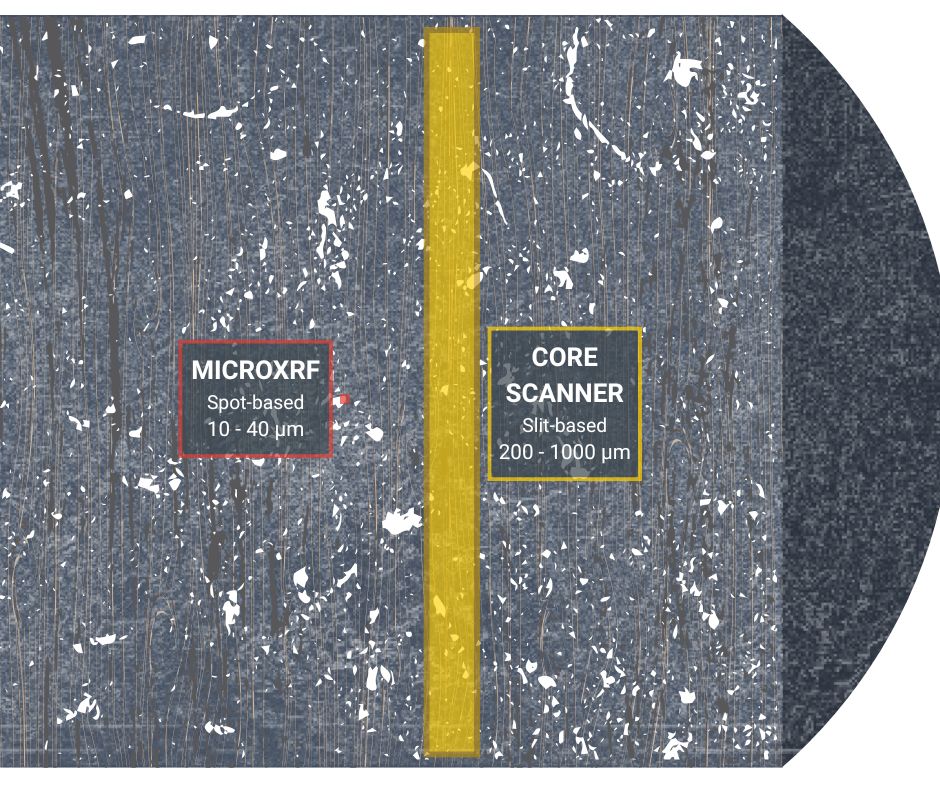
Figure 1. Comparison of analytical resolution footprints for MicroXRF (spot-based, 10–40 µm) versus a traditional core scanner (slit-based, 200–1000 µm) shown on a rock core surface. The MicroXRF footprint highlights its ability to resolve fine-scale mineral textures and micro-features, while the much larger slit footprint of the core scanner represents the coarse averaging inherent to linear scanning systems.
A New Analytical Paradigm: High-Resolution MicroXRF
Enter the Atlas Apex X, part of a new class of microXRF imaging systems engineered for modern critical mineral analysis. Unlike core scanners, this platform is designed to visualize and quantify geochemical and mineralogical features at the scale at which they actually occur.
Its capabilities are distinguished by:
- <10 µm beam size, enabling true micro-feature detection.
- Perpendicular, distortion-free excitation geometry, eliminating slit artifacts.
- Vacuum-enhanced low-Z sensitivity, critical for silicates and light-element mineral systems.
- Up to four 65 mm² SDD detectors, delivering high-count-rate mapping.
- A 400 × 300 mm mapping field, suitable for entire thin sections, slabs, and core segments.
- Hyperspectral 2D chemical imaging, producing millions of high-resolution spectra.
- Mineral classification via a 4,000-phase reference library and PCA-driven workflows.
In practical terms, this means that the Atlas Apex X can reveal the “mineralogical architecture” that governs ore behavior—something a core scanner simply cannot do.

Figure 2. The Atlas Apex X high-resolution microXRF enables micron-scale imaging of mineralogical features that core scanners cannot resolve—revealing the critical mineral hosts, micro-inclusions, and reaction fronts that ultimately govern ore value and processing efficiency.
What High-Resolution Imaging Enables
1. Understanding Rare Earth Element Mineral Hosts
Most REE enrichment is contained within micron-scale minerals like monazite, xenotime, bastnäsite, or allanite. Core scanners tend to blur these into background noise; the Atlas Apex X isolates and maps them.
Strategic impact: companies gain a much clearer understanding of REE distribution, extraction methods, and processing risks.
2. Quantifying Niobium–Tantalum Oxides with Confidence
Columbite, tantalite, and pyrochlore grains often determine the value of pegmatite or carbonatite deposits. These minerals can vary chemically even within a single crystal. The Atlas Apex X can directly map these variations, revealing subtle but economically important shifts in mineral chemistry.
Strategic impact: improved metallurgy, more accurate resource models, and fewer surprises in downstream processing.
3. Revealing Lithium Mineralogy Through Proxy Mapping
Lithium cannot be detected by XRF, but its mineral hosts—spodumene, petalite, lepidolite—have highly specific Al–Si–K–F signatures.
The Atlas Apex X identifies and maps these minerals, differentiates them from nearby silicates, and reveals reaction rims and micro-textures that influence processing.
Strategic impact: enhanced prediction of beneficiation efficiency and more accurate recovery forecasts.
4. Locating Platinum-Group Metal Micro-Inclusions
PGEs often appear as sub–10 µm inclusions within sulfides or chromites. These inclusions are essential for evaluating PGE potential but are invisible to scanners.
The Apex X resolves them directly.
Strategic impact: organizations can evaluate PGE potential earlier and more accurately in exploration workflows.
5. Mapping Reaction Fronts and Alteration Zones
Critical mineral systems typically develop through intricate alteration or metasomatic processes. These reaction fronts govern metal mobility, concentration, and extraction behavior.
The Atlas Apex X reveals zoned alteration envelopes, elemental gradients, and multi-mineral intergrowths critical for ore interpretation.
Strategic impact: improved process design and more accurate capital planning.
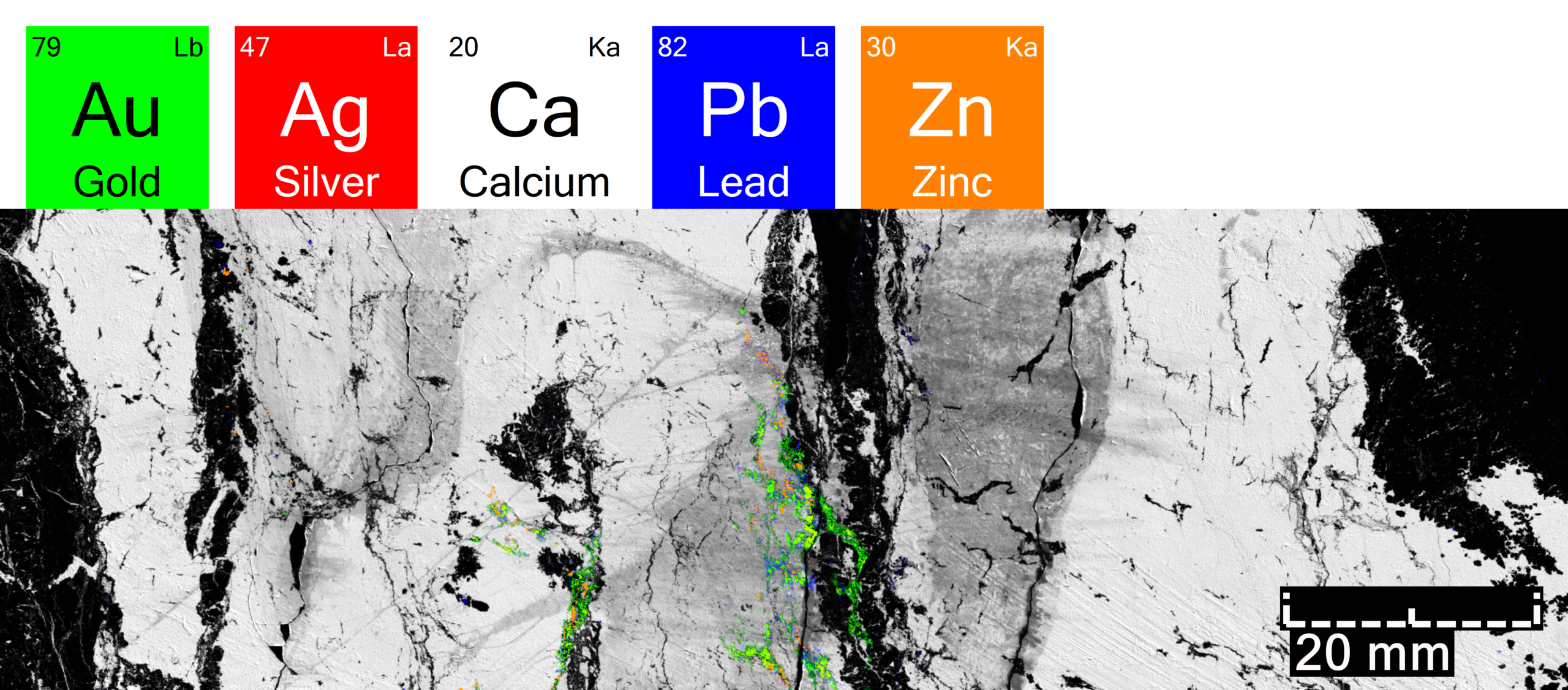
Figure 3. MicroXRF elemental map from a high-grade gold deposit from the Brucejack mine site, showing micrometer-scale distributions of Au, Ag, Pb, Zn, and Ca. Gold occurs both as discrete particles and in association with sulfide-hosted base metals, with Ag-rich zones indicating the presence of electrum. The 5 µm resolution of the Atlas microXRF reveals textural and mineralogical relationships that are invisible to traditional bulk techniques, providing key insights into gold deportment, mineralization history, and downstream processing behavior.
The Competitive Edge: Clarity at the Scale That Matters
The implications extend far beyond technical refinement.
Organizations using microXRF gain:
- More accurate resource assessments.
- Better prediction of processing outcomes.
- Reduced uncertainty in feasibility studies.
- Higher confidence in investment decisions.
- Accelerated timelines from exploration to production.
In a marketplace where supply constraints are tightening and strategic minerals are becoming geopolitical assets, the ability to see the deposit clearly at the micro-scale becomes a key advantage.
High-resolution microXRF does more than improve geochemistry—it enhances strategy.
A Future Built on Micro-Level Insight
As demand for critical minerals increases, so does the need for analytical tools that reveal mineral systems at the scale where value is created and lost. The Atlas Apex X is not just an upgrade to current workflows—it represents a transformation in how companies understand and utilize their geological information.
For organizations involved in the energy transition, the message is clear:
To compete in a world defined by critical minerals, you must analyze them at the scale that determines their behavior.
The Atlas Apex X brings that scale into focus.
Ready to uncover the mineralogical details that determine extraction success?