⚡TL;DR
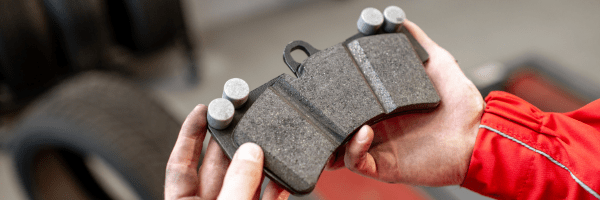
Brake pads are among the more chemically complex engineered materials in an automobile. Rather than being made from a single friction material, modern pads can contain more than ten distinct ingredients selected to balance friction, wear, thermal stability, noise, mechanical strength, and environmental requirements. Materials such as iron, barium compounds, titanates, copper or copper substitutes, zirconium-bearing abrasives, graphite, reinforcing fibers, fillers, and polymeric binders can each perform different functions. What matters is not only which elements are present, but where they occur and how they are distributed through the friction material.
MicroXRF elemental mapping provides a non-destructive way to visualize that chemical architecture across an entire brake pad, revealing features and compositional relationships that are easily lost in bulk chemical measurements.
A Brake Pad Is an Engineered Materials System
A driver presses the brake pedal and expects a predictable result. Behind that seemingly simple interaction is an unusually difficult materials-engineering problem.
A brake pad must generate enough friction to slow a vehicle while simultaneously resisting wear, dissipating heat, remaining mechanically intact, limiting noise and vibration, operating across changing temperatures and pressures, and increasingly satisfying restrictions on substances released through brake wear.
No single material can perform all of those functions well. The practical solution has been to create a multiphase composite.
Modern friction materials are commonly described in terms of several functional groups: binders, reinforcing fibers, fillers, abrasives, and friction modifiers or lubricants. Commercial formulations can contain ten, twenty, or more individual ingredients.
That complexity is not accidental. It is the engineering strategy.
Binders: Holding the System Together
The matrix of many non-asbestos organic brake materials is based on a thermosetting polymer, commonly a phenolic resin. The binder holds the heterogeneous mixture together, transfers forces among particles and fibers, and helps the material retain its shape during repeated braking cycles. But a binder alone would not make an effective brake pad. Pure resin does not provide the combination of thermal conductivity, wear resistance, structural reinforcement, and controlled friction required during braking.
The remaining ingredients modify those properties.
Reinforcements: Providing Mechanical Integrity
Metallic, ceramic, mineral, carbonaceous, glass, and aramid-based fibers can reinforce the composite.
Steel fibers, for example, can contribute strength and thermal conductivity. Potassium titanate has also been studied extensively as a reinforcement and friction-material constituent, including as an alternative to older asbestos-based reinforcement systems.
The morphology and distribution of these reinforcing phases can matter as much as their average concentration.
Abrasives: Creating and Maintaining Friction
Some constituents are deliberately hard.
Abrasive particles help control friction and influence the development of the contact surface between the pad and rotor. Materials such as zirconium silicate, alumina, silica-containing phases, and other ceramic particles can be incorporated for this purpose. Research has shown that abrasive particle chemistry, hardness, morphology, and size can all influence friction and wear behavior.
Too little abrasive action can reduce braking effectiveness. Too much can accelerate rotor and pad wear. The formulation therefore represents a compromise rather than a maximization exercise.
Lubricants and Friction Modifiers: Controlling the Interface
A brake pad also contains materials whose job is effectively to moderate friction.
Graphite is one of the most widely used solid lubricants in friction materials. Its layered structure and thermal properties can help promote smoother sliding, stabilize the coefficient of friction, and reduce wear.
Metal sulfides and other friction modifiers may perform similar functions.
The apparent contradiction, adding abrasives and lubricants to the same material, is exactly what makes brake formulation interesting. One group helps generate friction and maintain the contact surface; another prevents that friction from becoming unstable or excessively destructive.
The Elements Tell Part of the Story
Elemental analysis provides another way to understand this engineered mixture.
The attached microXRF maps reveal distributions of S, K, Ca, Ti, Cr, Mn, Fe, Ni, Cu, Zn, As, Rb, Zr, and Ba across the brake-pad material.
Importantly, an elemental map identifies an element, not necessarily its exact chemical compound. Determining whether barium exists specifically as BaSO₄, for example, requires interpretation of elemental associations and, where necessary, complementary phase-identification methods.
Nevertheless, several elements provide valuable clues about the architecture of friction materials.
| Element | Potential brake-material association | Functional significance |
| Fe — Iron | Steel fibers, iron-bearing particles, metallic reinforcement | Mechanical reinforcement, thermal transport, friction and wear behavior |
| Ba — Barium | Commonly barium sulfate/barite | Filler; contributes to thermal and friction characteristics |
| S — Sulfur | Sulfates and metal sulfides | Can indicate barite or sulfide-based friction modifiers/lubricants |
| Ti — Titanium | Potassium titanates, titanium-containing minerals or TiO₂ | Reinforcement, friction modification, formulation stability |
| K — Potassium | Potassium titanate and other K-bearing phases | Potential marker for titanate reinforcement/friction phases |
| Cu — Copper | Copper particles, fibers or brass-containing phases | Historically used for thermal management and friction modification |
| Zn — Zinc | Brass-associated Zn or other zinc-bearing modifiers | May contribute to friction-system chemistry or metallic phases |
| Zr — Zirconium | Frequently zircon/zirconium silicate | Hard abrasive used to influence friction and surface conditioning |
| Ca — Calcium | Calcium carbonate or other mineral fillers | Filler and formulation-property control |
| Cr, Mn, Ni | Alloy particles, steel constituents or discrete mineral/oxide phases | May reflect metallic reinforcement or hard friction-modifying phases |
| As, Rb | Minor or trace constituents | Potential impurities or minor mineral components; interpretation depends on formulation |
Barium sulfate is a particularly common filler in brake friction materials and has been associated with thermal stability and friction behavior.
Likewise, potassium titanate has been extensively investigated for its influence on friction performance and reinforcement, while zirconium-containing particles such as zircon have been studied as abrasives. Copper deserves special attention.
Historically, copper and copper-containing materials have been used in brake formulations because of useful thermal and tribological properties. However, environmental concerns about copper released through brake wear drove a major industry transition. A U.S. EPA-industry initiative called for copper content in brake friction materials to decline to below 5% by weight and ultimately to 0.5%.
That shift creates an additional materials challenge: when you remove one multifunctional ingredient, other materials must reproduce its performance without creating new compromises.
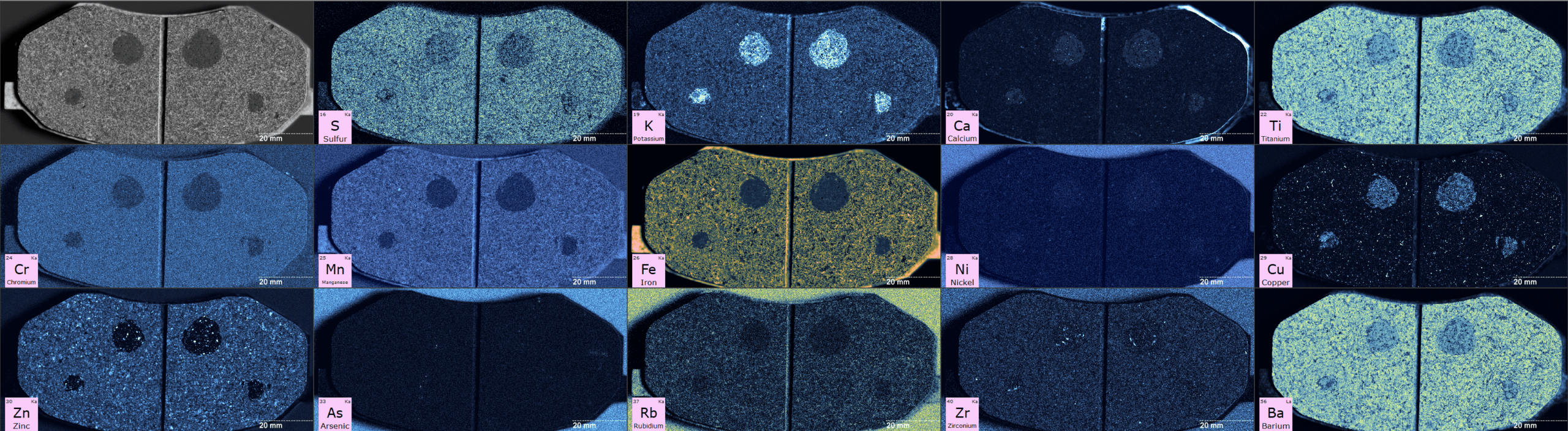
Figure 1. MicroXRF Elemental Mapping of Brake-Pad Friction Material. MicroXRF overview image and elemental maps of brake-pad friction material showing the spatial distribution of S, K, Ca, Ti, Cr, Mn, Fe, Ni, Cu, Zn, As, Rb, Zr, and Ba. The maps reveal a strongly heterogeneous multiphase composition, including broadly distributed matrix constituents and localized elemental features associated with discrete particles or formulation components. Differences in the distributions of Fe, Cu, Zn, Ba, Ti, Zr, and other elements demonstrate that brake-pad chemistry cannot be fully understood from bulk composition alone. Scale bars = 20 mm.
Why Spatial Distribution Matters
A conventional bulk XRF measurement might tell an engineer that a brake pad contains iron, barium, titanium, copper, zinc, and zirconium. Useful information, but incomplete information.
Consider two pads containing exactly the same bulk concentration of an element. In the first pad, that element is finely and uniformly dispersed. In the second, it occurs in a limited number of large particles.
Chemically, the average concentration may be identical. Functionally, the materials may behave very differently.
Particle distribution can influence:
- local thermal conductivity
- abrasive contact with the rotor
- development of friction layers
- mechanical reinforcement
- localized wear
- material transfer to the rotor
- formulation uniformity
- manufacturing consistency
This is where elemental imaging changes the analytical question.
Instead of asking: “How much iron, copper, barium, or zirconium is in this brake pad?”
The engineer can begin asking: “Where is it?” And then: “What is it associated with?”
That transition, from concentration to spatial context, is one of the most valuable aspects of microXRF.
The Maps Reveal an Engineered Microstructure
Look closely at the brake-pad maps. Some elemental signals extend through much of the friction material. Others form discrete particles, circular regions, or localized concentrations.
Iron is distributed very differently from copper. Barium exhibits patterns unlike zirconium. Potassium-rich features can be compared with titanium to investigate possible titanate-containing constituents. Sulfur can be compared spatially with barium or other metals to test hypotheses regarding sulfate- or sulfide-bearing phases. You can examine copper and zinc distributions together for evidence of metallic or alloy-containing particles.
But individual elemental maps are only one way to interrogate a hyperspectral dataset. Combining several elements into a multi-element overlay can make compositional relationships even easier to recognize.
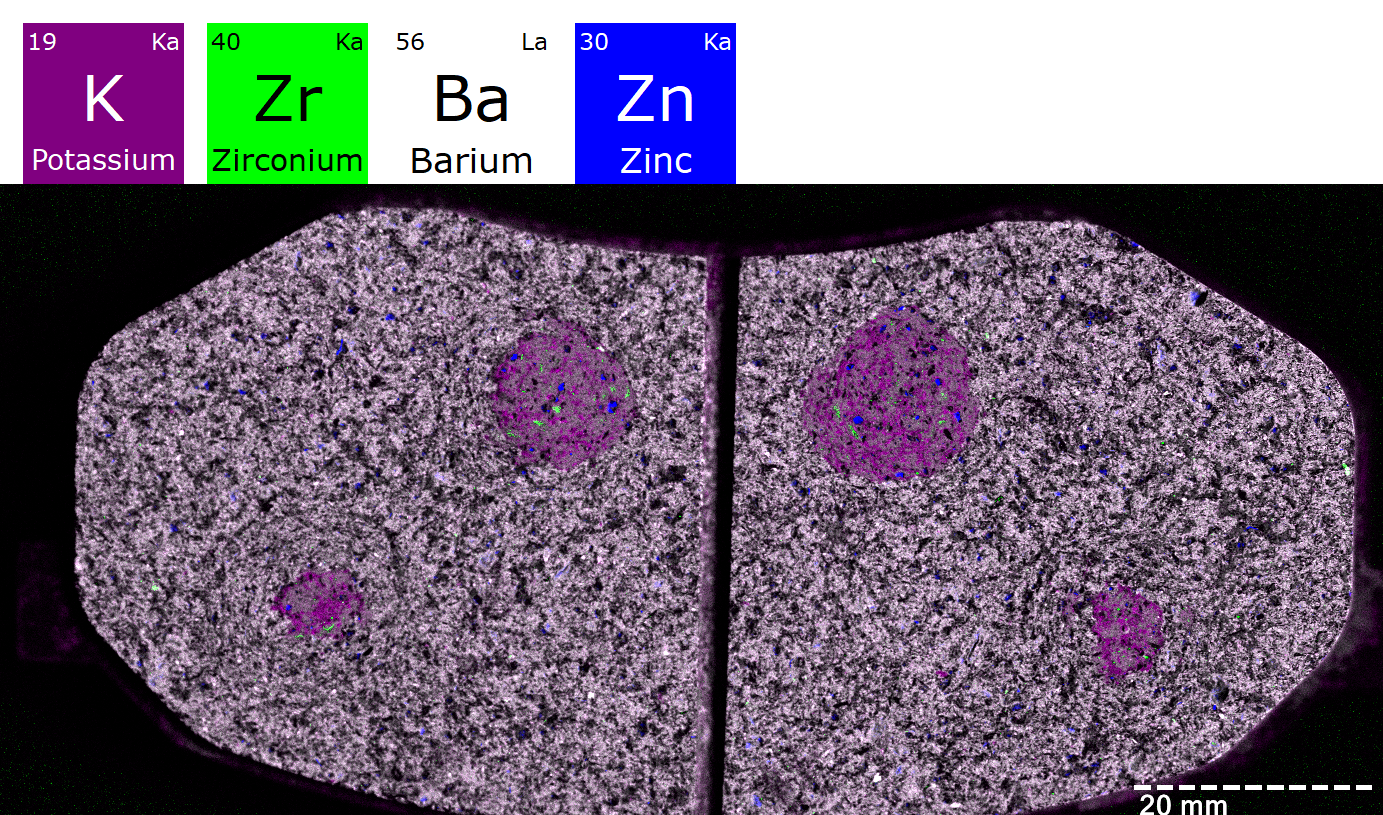
Figure 2. Four-Element MicroXRF Overlay of the Brake-Pad Friction Material. Four-element microXRF overlay showing potassium (K, magenta), zirconium (Zr, green), barium (Ba, white), and zinc (Zn, blue) across the brake-pad friction material. The overlay makes differences in elemental distribution immediately apparent: Ba is broadly distributed throughout much of the pad, while K is strongly concentrated within several large circular regions. Zr and Zn occur as smaller, discrete localized features distributed through the material and within some of the K-rich regions. Viewing several elemental distributions simultaneously helps reveal spatial associations, segregation, and particle-scale heterogeneity that are more difficult to recognize from bulk measurements or isolated elemental maps.
The four-element overlay illustrates an important analytical distinction.
An elemental map answers: Where is this element?
An overlay begins to answer: Which elements occupy the same regions and which clearly do not?
In this example, the broadly distributed Ba signal contrasts strongly with the concentrated K-rich circular features and the much smaller Zr- and Zn-rich particles.
That does not, by itself, establish the identity of a specific chemical compound. But it provides a powerful way to identify regions worth investigating more closely.
If K and Ti repeatedly co-localize, for example, that relationship may support further investigation of a potassium-titanate-containing constituent. If Ba and S occupy the same regions, you can evaluate their association for consistency with a sulfate-bearing phase such as barite. Likewise, spatial relationships between Cu and Zn may provide clues about metallic or alloy-containing constituents.
The important point is that hyperspectral microXRF retains the spatial context necessary to test those relationships.
A complete spectrum is collected at each measurement position. Rather than simply generating a colored image, the dataset lets researchers move between maps, spectra, regions of interest, elemental overlays, and quantitative chemistry.
Atlas Apex is designed for spatially resolved elemental mapping and quantitative micro-scale materials characterization, enabling researchers to investigate compositional heterogeneity across large samples while retaining localized chemical information
This is particularly useful when comparing:
- competing brake formulations
- prototype versus production materials
- different pad manufacturers
- incoming raw materials
- worn versus unworn friction surfaces
- localized defects
- manufacturing variability
- copper-containing versus copper-reduced formulations
Brake Wear Makes Composition Even More Important
Brake chemistry is no longer only a question of stopping performance. It is increasingly an environmental materials problem.
Mechanical wear releases particles derived from both the pad and the rotor. Research on brake-wear particles frequently identifies elements including Fe, Cu, Ba, Ti, Zn, and related constituents, although their relative abundance depends strongly on the friction pair and formulation.
That creates a new optimization problem for friction-material developers.
The objective is no longer simply: maximize performance and minimize wear.
It increasingly becomes: maintain braking performance, durability, thermal stability, NVH behavior, manufacturing practicality, and cost while also controlling the chemistry and quantity of emitted particles.
That is a much harder materials-science problem. And it makes understanding the spatial distribution of individual formulation components increasingly valuable.
From “What Is It Made Of?” to “How Is It Engineered?”
Complex materials are often characterized by reducing them to a number. Percent iron. Percent copper. Percent barium. Percent titanium.
But brake pads illustrate why composition alone can be an incomplete descriptor of material behavior.
The important information exists at several levels simultaneously:
- What elements are present?
- Which compounds or phases contain them?
- How large are those phases?
- Where are they located?
- How uniformly are they distributed?
- How do those distributions change after braking and wear?
This is the broader analytical opportunity microXRF offers.
It allows researchers and materials engineers to study chemistry within its physical context, across millimeters, particles, inclusions, regions, and entire components, without destroying the specimen.
For a material as heterogeneous as a brake pad, that context can be the difference between simply identifying ingredients and understanding how the formulation was engineered.
See More of the Brake-Pad Dataset
What Could Elemental Mapping Reveal in Your Friction Material?
Want to see the full brake-pad microXRF dataset, acquisition conditions, additional elemental maps, or examples of how Atlas Apex can be used to compare friction-material formulations?
Ask IXRF Systems for more details.
Our applications team can discuss the brake-pad analysis shown here, review your analytical requirements, or evaluate one of your own brake, friction, wear, or advanced-material samples.
Request to send us a sample for evaluation.
FAQ
What are brake pads made of?
Modern automotive brake pads are engineered composites, not single materials. Formulations typically contain binders, reinforcement fibers, fillers, abrasives, and friction modifiers selected to control friction, wear, heat, strength, and noise.
Why is barium found in brake pads?
Barium is commonly associated with barium sulfate, or barite, which is widely used as a filler in brake friction materials and can contribute to thermal and frictional behavior.
Why is copper used in brake pads?
Copper has historically been incorporated into friction materials for useful thermal and tribological properties. Environmental concerns about copper released through brake wear have led manufacturers toward low-copper and copper-free formulations.
What does zirconium do in a brake pad?
Zirconium may occur in zirconium-containing abrasives such as zircon. Hard abrasive particles are used to influence friction, wear, and conditioning of the pad–rotor contact surface.
What can microXRF reveal about a brake pad?
MicroXRF can map the distribution of elements across a brake pad rather than reporting only average bulk composition. This allows researchers to visualize discrete particles, compositional regions, and spatial relationships among different elements.
Can microXRF determine which compounds are present?
MicroXRF directly measures elemental composition. Spatial correlations among elements can provide evidence for particular ingredients or phases, but elemental maps alone should not automatically be interpreted as definitive compound identification. Complementary phase-analysis techniques may be useful when exact chemical or crystallographic identification is required.
Is microXRF destructive?
MicroXRF is generally a non-destructive elemental characterization technique, allowing samples or components to be mapped with little or no destructive preparation. Atlas Apex is designed specifically for non-destructive spatially resolved materials characterization.