
Atlas in Action: Mapping the Chemistry of 2.7-Billion-Year-Old Komatiitic Basalts
Atlas in Action highlights how researchers are using Atlas microXRF systems in real-world applications. Each customer spotlight demonstrates how elemental mapping helps reveal meaningful spatial relationships within complex samples.
In this installment, researchers at the U.S. Geological Survey in Spokane, Washington, used an Atlas M microXRF to investigate preserved mineral textures in Archean komatiitic basalt flows—helping connect microscopic chemistry with magma evolution and mineralization potential.
What can mineral textures preserved in 2.7-billion-year-old lava flows tell us about the early Earth—and the processes that concentrated or redistributed valuable metals?
Researchers with the U.S. Geological Survey (USGS) investigated the Bradley Peak greenstone terrane in central Wyoming, where ancient volcanic rocks preserve distinctive spinifex and cumulate textures formed during the cooling and crystallization of high-temperature magmas.
Komatiitic volcanic rocks are important to both early-Earth studies and economic geology. These magnesium-rich volcanic systems can provide information about the thermal and chemical evolution of the Archean mantle, and elsewhere in the world they are important hosts for nickel-copper-platinum-group element (Ni-Cu-PGE) sulfide mineralization.
Yet the komatiitic rocks of the Archean Wyoming Province have received relatively little attention compared with better-known greenstone belts in Canada, Australia, and South Africa.
The USGS research team combined field mapping, geochronology, whole-rock geochemistry, isotope geochemistry, electron microprobe analysis, thermodynamic modeling, and laboratory microXRF mapping to reconstruct the history of the Bradley Peak volcanic rocks and evaluate their mineralization potential.
How Is MicroXRF Used in Igneous Petrology?
Igneous petrology often depends on understanding not only which elements and minerals are present, but where they occur and how their distributions relate to mineral textures.
That distinction becomes particularly important in ancient rocks that have experienced billions of years of alteration and metamorphism.
Representative thin sections and rock slabs from Bradley Peak were mapped using an Atlas M microXRF at the U.S. Geological Survey laboratory in Spokane, Washington. The researchers analyzed selected spinifex-textured and cumulate samples using a 10 µm X-ray beam, 10–25 µm pixel spacing, 50 ms dwell times, and two silicon drift detectors, including a light-element detector.

The resulting XRF spectra were deconvoluted to address overlapping peaks, and false-color elemental overlays were generated using Iridium Ultra software.
Rather than reducing each specimen to a single bulk chemical measurement, microXRF provided spatially resolved maps that could be compared directly with recognizable mineral textures.
What Can MicroXRF Reveal in Komatiitic Rocks?
Despite extensive alteration, the Bradley Peak rocks preserve remarkable evidence of their original volcanic textures.
The study identified approximately 150 meters of stratigraphy containing at least five stacked komatiitic flows. The sequences include random spinifex textures, oriented spinifex—sometimes described as “string-beef” texture—and serpentinized olivine cumulates.
MicroXRF mapping made many of these relationships particularly clear because different minerals and compositional zones could be distinguished through their elemental signatures.
How Can Elemental Mapping Identify Spinifex Textures?
One of the most revealing observations involved chemical zoning within individual spinifex needles.
Some mapped crystals displayed iron-rich cores surrounded by calcium-rich rims. The researchers interpreted this pattern as evidence that the original pyroxenes contained pigeonite cores and augite rims—a mineralogical relationship commonly associated with pyroxene spinifex in komatiitic basalt flows.
The maps also helped establish that the spinifex needles were pseudomorphs after pyroxene rather than olivine. The needles had been replaced by amphibole, contained elevated chromium, and exhibited acicular rather than platy morphology.
In coarse-oriented samples, microXRF maps of rock slabs cut both parallel and perpendicular to the spinifex needles revealed another unusual feature: the crystals had extremely high aspect ratios and hollow internal structures.
These morphological characteristics provide clues to the thermal history of the lava. Experimental studies cited by the authors associate hollow, oriented pyroxene spinifex with relatively slower cooling and strong thermal gradients within a komatiitic basalt flow, whereas finer random spinifex is associated with more rapidly cooled portions of the flow.
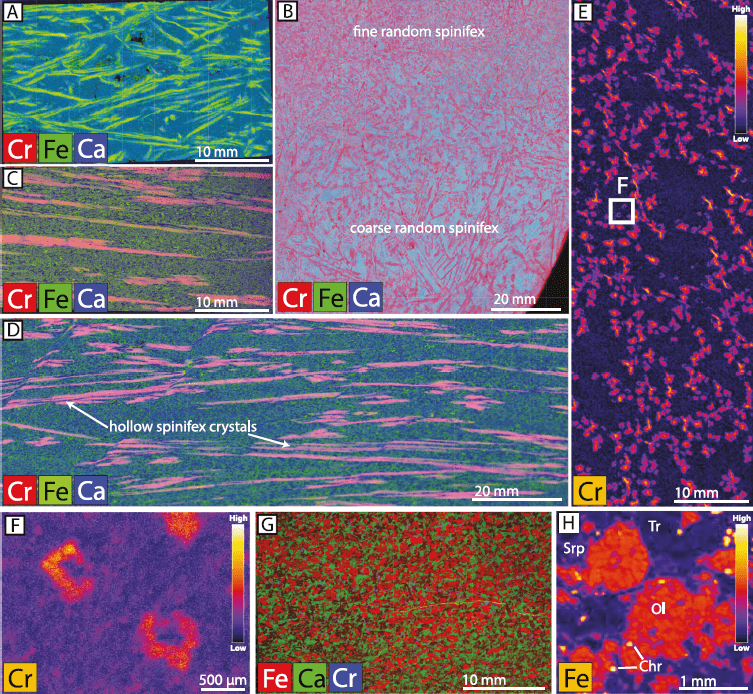
Figure 1. False-color microXRF maps collected with an Atlas M at the U.S. Geological Survey in Spokane illustrate representative textures and mineralogy within the Bradley Peak komatiitic basalt flows. Chromium, iron, and calcium distributions reveal random and oriented spinifex textures, including zoned needles with Fe-rich cores and Ca-rich rims. Maps of sections cut parallel and perpendicular to coarse spinifex crystals demonstrate their high aspect ratio and hollow character, while higher-resolution maps identify chromite, relict olivine, serpentine, tremolite, and other features within altered olivine cumulates. Together, the maps show how spatially resolved elemental chemistry can preserve evidence of primary igneous textures even in rocks that have undergone extensive alteration and metamorphism. Source: Zieman et al. (2025), Precambrian Research, CC BY 4.0.
How Can MicroXRF Complement Whole-Rock Geochemistry?
MicroXRF was one component of a much broader analytical workflow—and that combination is what made the study particularly informative.
Whole-rock major and trace element analysis established that the spinifex-textured samples are Al-undepleted komatiitic basalts, containing approximately 11–17 wt% MgO. Sm-Nd isotopes provided information about the magma source, while zircon U-Pb geochronology helped constrain the timing of volcanism. Electron microprobe measurements provided quantitative olivine chemistry.
MicroXRF supplied something different: textural and spatial context.
The elemental maps allowed researchers to connect chemistry with individual minerals, zoning patterns, crystal morphology, and the position of those textures within the volcanic sequence.
This spatial evidence strengthened the interpretation of how the rocks crystallized and helped researchers relate whole-rock compositions back to processes occurring within individual lava flows.
Taken together, the evidence supports an eruption age of approximately 2.72 billion years for the Bradley Peak komatiitic basalts.
The researchers estimated that the primary mantle-derived magma contained approximately 19 wt% MgO and formed through roughly 15–25% partial melting at pressures of 3–4 GPa.
The chemistry also revealed another important part of the story.
What Does Banded Iron Formation Reveal About the Magma’s History?
Banded iron formation, or BIF, occurs interbedded with rocks of the Bradley Peak succession.
Trace-element chemistry and thermodynamic modeling led the researchers to investigate whether the original magma had interacted with this local material.
Their modeling indicates that assimilation of approximately 15% BIF could account for important features of the observed major- and trace-element compositions.
The proposed scenario begins with a mantle-derived primary melt. As the magma interacted with BIF, it assimilated this material while crystallizing olivine and minor chromite. Subsequent crystallization and differentiation produced the compositional and textural variations preserved in the Bradley Peak samples today.
This interpretation demonstrates why combining spatial mineralogy, whole-rock geochemistry, isotope data, and modeling can provide a much more complete reconstruction of an ancient magmatic system than any single measurement alone.
Can MicroXRF Help Evaluate Mineralization Potential?
MicroXRF can contribute valuable mineralogical and textural context to mineral-exploration studies, but in this investigation the conclusions regarding mineralization came from the combined analytical dataset, particularly whole-rock PGE and chalcophile-element geochemistry, petrogenetic modeling, and field relationships.
That distinction is important.
Komatiite-hosted sulfide deposits commonly form when high-degree mantle melts interact with sulfur-bearing crust, allowing an immiscible sulfide liquid to develop and concentrate Ni, Cu, and platinum-group elements.
The Bradley Peak samples did not show positive evidence for that process.
PGE/Ti relationships did not display the extreme fractionation expected from substantial interaction with a sulfide liquid. Combined with the inferred mantle-melting conditions and limited assimilation of sulfur-rich material, the results suggest that the portions of the Bradley Peak flows examined in the study are unlikely to contain significant magmatic Ni-Cu-PGE sulfide mineralization.
The authors caution that their samples represent only a small portion of the original flow field, so sulfide mineralization elsewhere cannot be completely excluded.
Could These Rocks Instead Be a Source of Gold?
The gold story is particularly interesting.
Orogenic gold deposits have been known in the Seminoe Mountains since the late 1800s, and the region remains an active target for mineral exploration.
The USGS researchers found that the Bradley Peak komatiitic basalts and cumulates were consistently depleted in gold, with measured concentrations of approximately 0.3–1.0 ppb and an average of about 0.6 ppb.
Those concentrations are lower than typical values reported for many comparable komatiitic rocks.
Rather than suggesting that the system simply lacked gold, the researchers propose that gold may have been mobilized out of the ultramafic rocks during later hydrothermal processes.
That interpretation supports the possibility that the Bradley Peak ultramafic rocks served as a source of gold for nearby orogenic quartz-carbonate vein deposits in the Seminoe Mountains. Copper and potentially sulfur may also have been mobilized.
In mineral exploration, identifying where an element has been depleted can sometimes be as informative as identifying where it has been concentrated.
Why This Study Matters
The Bradley Peak investigation shows the value of studying geology across multiple scales.
Field mapping established the volcanic architecture. Geochronology constrained its age. Whole-rock and isotope geochemistry helped reconstruct the magma source and evolution. Thermodynamic models tested potential petrogenetic processes.
MicroXRF helped connect those larger-scale interpretations back to the rocks themselves by revealing where elemental variations occurred within preserved mineral textures.
In samples that have endured approximately 2.7 billion years of geological history, spatially resolved elemental mapping helped researchers distinguish mineral zoning, recognize different spinifex morphologies, examine relict olivine and chromite, and preserve the context needed to interpret those features.
The result is a more complete picture of an ancient volcanic system—and a better understanding of what that system may mean for mineral exploration today.
From microscopic mineral textures to billion-year-scale geological processes—that is Atlas in Action.
Researchers and Institution
The research was conducted by Lisa J. Zieman, M. Christopher Jenkins, and Jacob E. Poletti of the U.S. Geological Survey Geology, Minerals, Energy, and Geophysics Science Center in Spokane, Washington.
Author profiles:
Lisa J. Zieman — U.S. Geological Survey / LinkedIn
M. Christopher Jenkins — U.S. Geological Survey
Jacob E. Poletti — U.S. Geological Survey
Read the Research
Publication: Petrogenesis and mineralization potential of spinifex komatiitic basalts in the Bradley Peak greenstone terrane, Wyoming Province
Journal: Precambrian Research, Volume 430, Article 107929
DOI: 10.1016/j.precamres.2025.107929
The supporting USGS data release also includes geochemistry, olivine chemistry, isotope data, sample information, and microXRF chemical maps generated during the investigation.
Could MicroXRF Add Spatial Context to Your Research?
When elemental distribution, mineral zoning, alteration patterns, phase relationships, or small-scale chemical variations matter, bulk composition may only tell part of the story.
Have a geological sample or research question you would like to explore? Talk with the IXRF Systems applications team about your samples and analytical goals. We can help determine whether microXRF mapping could provide useful spatial chemical information—and, when appropriate, evaluate your samples to show what the technique can reveal.