
⚡TL; DR — High-resolution microXRF mapping with the Atlas Apex M reveals that lava is not chemically uniform but spatially structured—capturing flow dynamics, elemental segregation, and post-emplacement alteration. This transforms geochemical analysis from bulk composition into process-driven insight, enabling better interpretation of volcanic systems on Earth and beyond.
Estimated read time: ~5–6 minutes.
Volcanic rocks are often reduced to simple classifications—basalt, andesite, rhyolite—summarized by bulk chemistry and mineral content. But this simplification obscures the real story. Lava is not homogeneous. It is a dynamic archive of flow, crystallization, chemical segregation, and post-emplacement alteration.
The challenge has never been whether this complexity exists—it has been whether we can resolve it spatially.
Recent high-resolution microXRF mapping of a lava flank sample from INAF demonstrates that we can—and that doing so fundamentally changes how we understand volcanic systems, both on Earth and across the solar system.
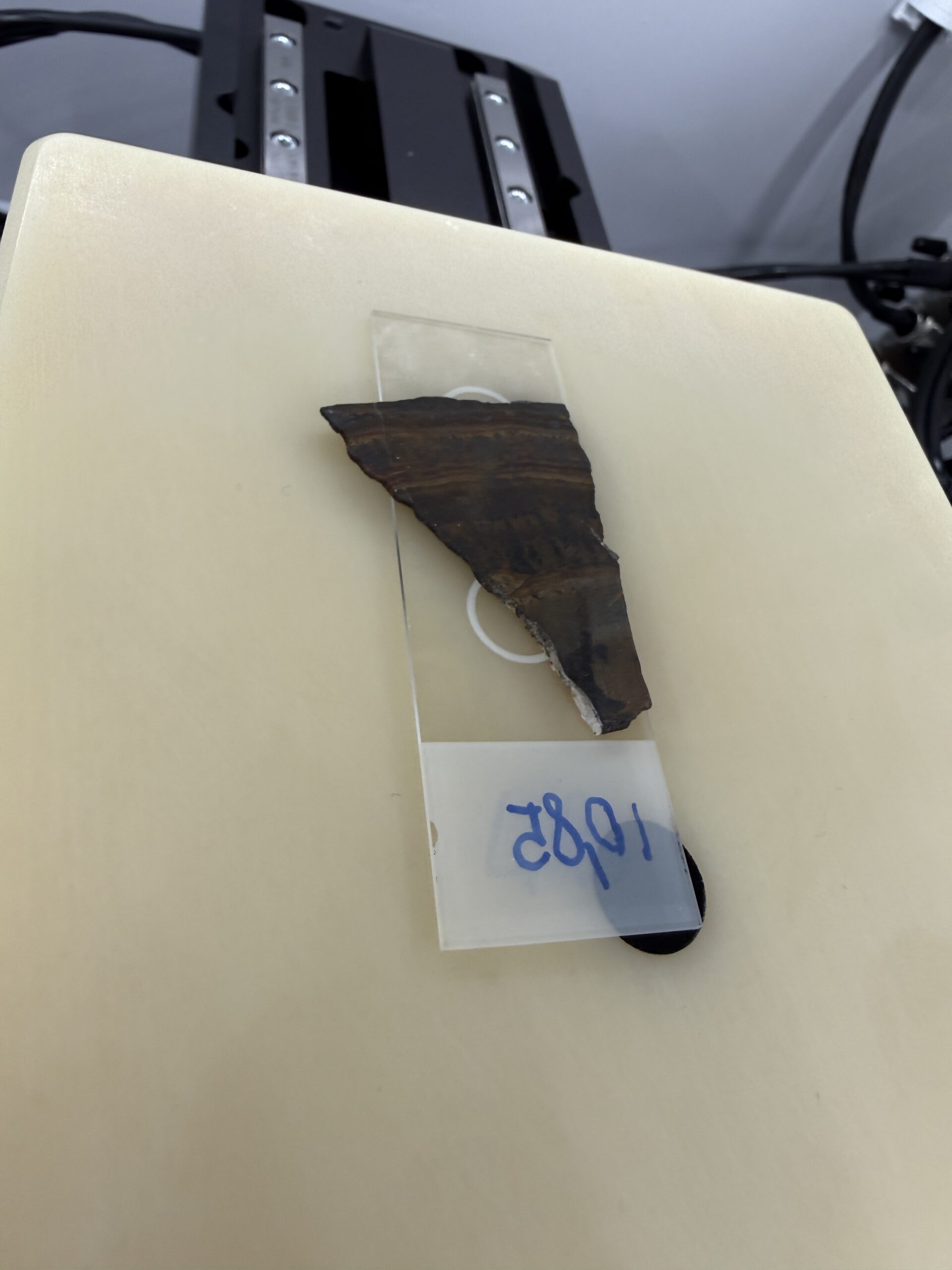
Figure 1. Lava flank sample prepared for analysis on the Atlas Apex M microXRF system.
From Chemistry to Context: A Shift in Analytical Thinking
Traditional geochemical methods answer a narrow question: what is this material made of?
MicroXRF mapping answers a more powerful one: how is that composition distributed—and what processes created that distribution?
Using the Atlas Apex M microXRF platform developed by IXRF Systems, researchers generated high-resolution elemental maps that preserve both chemical detail and spatial relationships across the sample.
This approach transforms geochemical analysis from static data into process-driven insight.
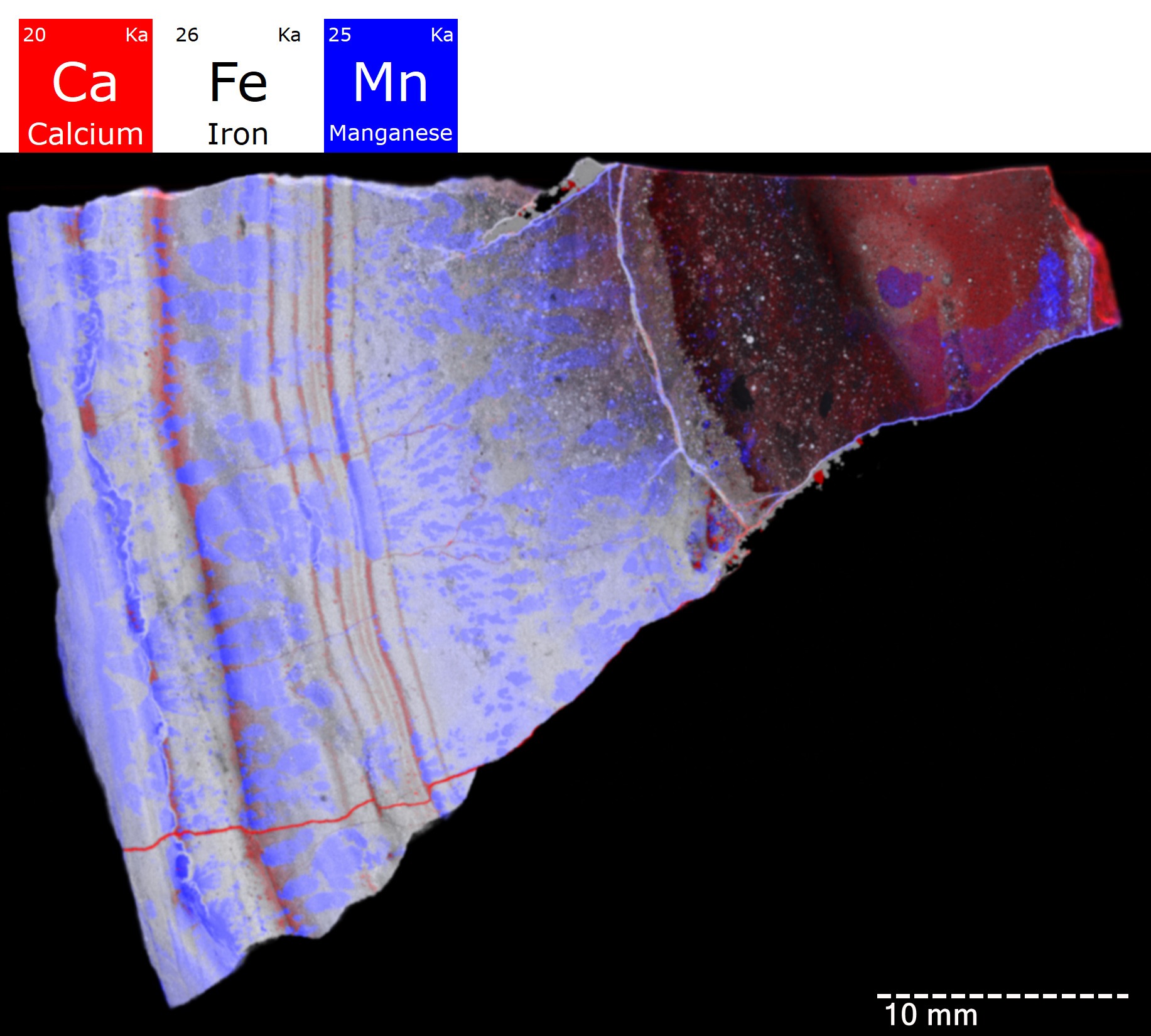
Figure 2. High-resolution microXRF elemental map (Ca–Fe–Mn) revealing flow banding, compositional zoning, and fracture-controlled alteration in a lava flank sample.
Structural Memory in Lava: Flow, Cooling, and Alteration
The elemental overlay (Ca, Fe, Mn) reveals a chemically and texturally heterogeneous volcanic fragment, where each feature reflects a specific stage in the material’s evolution.
The Fe-rich matrix dominates large portions of the sample, consistent with a rapidly cooled volcanic groundmass composed of iron-bearing silicates. Within this matrix, Mn appears diffusely distributed, suggesting substitution within primary mineral phases or subtle redistribution during cooling.
Cutting through this matrix are vertically aligned Ca-rich bands—clear evidence of flow banding. These features are not random; they reflect the internal dynamics of the lava during emplacement. As the lava flowed, thermal gradients and shear forces enabled localized chemical segregation, preserving compositional layering at the millimeter scale.
A diagonal fracture disrupts this structure, creating a sharp structural discontinuity. Along this fracture, localized enrichment in Ca and Mn suggests that it served as a pathway for fluid movement after solidification. This indicates a transition from primary magmatic processes to secondary alteration, where external fluids interact with the rock and redistribute elements.
What emerges is a layered narrative:
Initial flow and emplacement, followed by cooling and crystallization, and finally structural modification through fracturing and fluid interaction.
Why This Matters: From Volcanic Systems to Strategic Insight
At first glance, mapping elements across a small lava fragment may seem highly specialized. In reality, it addresses broader challenges across multiple domains.
Understanding spatial geochemistry at this level contributes directly to:
- Volcanic hazard assessment, where flow dynamics and fracture development influence structural stability
- Geochemical modeling, improving predictions of how magmatic systems evolve during cooling
- Materials science, where natural analogs inform high-temperature processing and phase segregation
- Energy and resource exploration, where elemental distribution informs mineralization pathways
The key insight is simple but powerful: composition alone is not enough—distribution is what reveals process.
Extending the Insight: A Framework for Planetary Interpretation
The implications extend beyond Earth.
Volcanic terrains dominate the surfaces of Mars, Moon, and Venus. Yet our understanding of these environments is largely derived from orbital data and limited in situ measurements.
The spatial patterns observed in this lava flank sample—flow banding, compositional zoning, and fracture-controlled alteration—provide a terrestrial analog for interpreting planetary surfaces.
For example:
- Flow-aligned chemical banding offers insight into lava emplacement mechanisms on Mars and the Moon
- Elemental zoning helps refine models of cooling rates and crystallization under varying gravity and atmospheric conditions
- Fracture-associated redistribution provides a framework for understanding fluid interaction and alteration processes on planetary surfaces
As planetary science increasingly moves toward spatially resolved datasets—from rover-based instruments to sample return missions—the ability to interpret these patterns becomes critical.
This research helps build that interpretive foundation.
The Enabler: Atlas Apex M microXRF
The strategic shift is clear.
When we move from bulk measurements to spatially resolved data, we move from describing materials to understanding processes. We gain the ability to reconstruct how a system formed, how it evolved, and how it was modified over time.
That shift has implications far beyond volcanology. It informs how we explore resources, model planetary systems, and design materials.
Because ultimately, whether we are studying a lava flank on Earth or a volcanic plain on another planet, the objective is the same:
To turn complexity into clarity—and insight into action.
Turn Insight into Advantage
If your work depends on understanding how materials form, evolve, and interact, then bulk chemistry is no longer enough. The difference between observation and insight lies in spatial resolution—and that is where the Atlas Apex platform changes the equation.
Whether you are investigating volcanic systems, mapping elemental distributions in complex materials, or advancing research in geochemistry, the ability to see chemistry in context will directly impact the quality and speed of your decisions.
The Atlas Apex M microXRF is designed to deliver that clarity—combining high-resolution mapping, analytical precision, and real-world usability into a single platform built for demanding applications.
If you are ready to move beyond averages and start working with actionable, spatially resolved data, now is the time to explore what Atlas Apex can do for your lab.
Connect with IXRF Systems today to schedule a discussion, request sample analysis, or see how the Atlas Apex M can be configured for your specific application.