⚡TL; DR — SEM and EDS are powerful tools for high-resolution imaging and micro-scale chemistry, but they are not designed to map large areas or detect low-level trace elements across whole samples. MicroXRF changes that. It allows researchers to map entire thin sections or core segments, detect elements down to single-digit ppm, and visualize zonation patterns that are often invisible with SEM alone.
The advantage is not about replacing SEM. It is about strengthening your workflow. If your geology depends on observing subtle compositional gradients at meaningful scales, microXRF expands what you can see.
Estimated read time: ~5–6 minutes.
For decades, SEM and EDS have been the default microanalytical platforms in geology and petrology labs. They remain indispensable for imaging, phase identification, and micron-scale chemical characterization.
But the strategic question facing research groups today is not whether SEM and EDS are valuable. It is this:
Are they sufficient on their own to answer modern geochemical questions at scale?
As mineral systems grow more complex, exploration budgets become more scrutinized, and analytical throughput becomes more critical, laboratories are increasingly integrating micro X-ray fluorescence, or microXRF, into their core workflows. Not as a replacement for SEM, but as a structural upgrade to the way geological data is generated.
At IXRF Systems, we see this shift firsthand. The Atlas Apex microXRF platform is being adopted not because it competes with SEM and EDS, but because it solves a different and often more strategic set of problems.
The Limitation Few Labs Acknowledge: Scale Mismatch
SEM and EDS are optimized for micron-scale interrogation. Geological systems are not.
Mineralization patterns, alteration halos, diffusion gradients, and metasomatic fronts often develop across millimeters to centimeters, not microns. When researchers attempt to reconstruct these systems using only small-area EDS maps, they risk missing broader zonation patterns. This creates a scale mismatch:
- Geological processes occur at centimeter to meter scales
- SEM and EDS operate most efficiently at microns
MicroXRF fills that gap. By enabling high-resolution elemental mapping across entire thin sections, hand samples, and core segments, microXRF captures compositional gradients that are simply invisible when confined to narrow SEM fields of view.
The implication is significant. Better spatial context leads to better geological interpretation.
Sensitivity Changes the Conversation
Detection limit is not just a technical specification. It is a decision variable. Typical SEM and EDS limits hover around 0.1 weight percent, or approximately 1000 ppm. For many trace element studies, that threshold is too high to reveal early enrichment, subtle zoning, or low-concentration transition metal distributions.
MicroXRF platforms such as Atlas Apex routinely achieve detection limits in the single-digit ppm range. That difference, 1000 ppm versus 5 to 10 ppm, fundamentally changes what researchers can see:
- Early-stage hydrothermal alteration
- Subtle nickel and cobalt zoning
- Rare earth element enrichment trends
- Trace metal partitioning in silicates
In exploration contexts, detecting these early signals can materially impact targeting decisions.
Depth of Information: Surface Versus Subsurface Insight
Electron beams are inherently surface-sensitive. Their interaction volume is confined to near-surface regions. X-ray excitation behaves differently.
MicroXRF uses photon-based excitation, enabling deeper information depth and greater bulk representativity. For heterogeneous geological samples, this reduces the risk of over-interpreting localized surface anomalies. In practical terms, microXRF provides:
- Improved transition metal excitation above 2 keV
- Stronger trace element detectability
- More representative bulk-phase mapping
For petrologists investigating diffusion profiles or metasomatic reactions, this distinction directly affects the integrity of interpretation.
Workflow Economics: Time, Preparation, and Instrument Utilization
Modern labs operate under budgetary and time constraints. Instrument time is expensive. Preparation time is expensive. Re-analysis is expensive. SEM and EDS typically require:
- Conductive coating for non-metallic samples
- Vacuum compatibility
- Flat, polished surfaces
MicroXRF requires none of these.
Samples can be analyzed uncoated, non-destructively, and often with minimal preparation. Large and irregular specimens can be accommodated directly. Strategically, this allows microXRF to function as a pre-characterization platform:
- Map entire sections rapidly
- Identify chemically relevant domains
- Target SEM time only where high-resolution imaging is necessary
The result is higher SEM utilization efficiency and fewer blind analytical passes.
Large-Area Mapping: Seeing the System, Not Just the Grain
In nickel systems, for example, SEM may identify compositional variation at the grain scale. But microXRF reveals how those grains are distributed throughout the sample, highlighting zonation patterns, structural control, and geochemical gradients over centimeters.
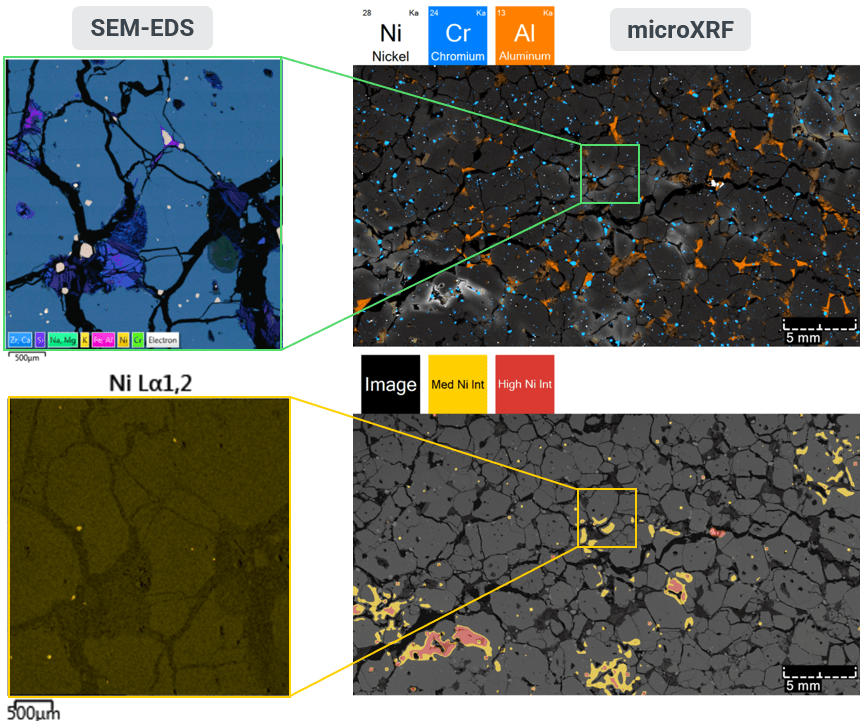
Figure 1. Large-area nickel zonation revealed by microXRF compared to localized SEM-EDS mapping. Broader compositional gradients become visible only at scale.
This macro-to-micro integration strengthens interpretation. It also aligns analytical resolution with geological reality.
Strategic Positioning: Complementary, Not Competitive
It is tempting to frame microXRF and SEM with EDS as competing technologies. That framing is incomplete.
They occupy different domains:
- SEM and EDS for micron-scale imaging and compositional detail
- MicroXRF for millimeter to centimeter scale elemental mapping with low detection limits
- EPMA and LA-ICP-MS for precision quantification and ultra-trace analysis
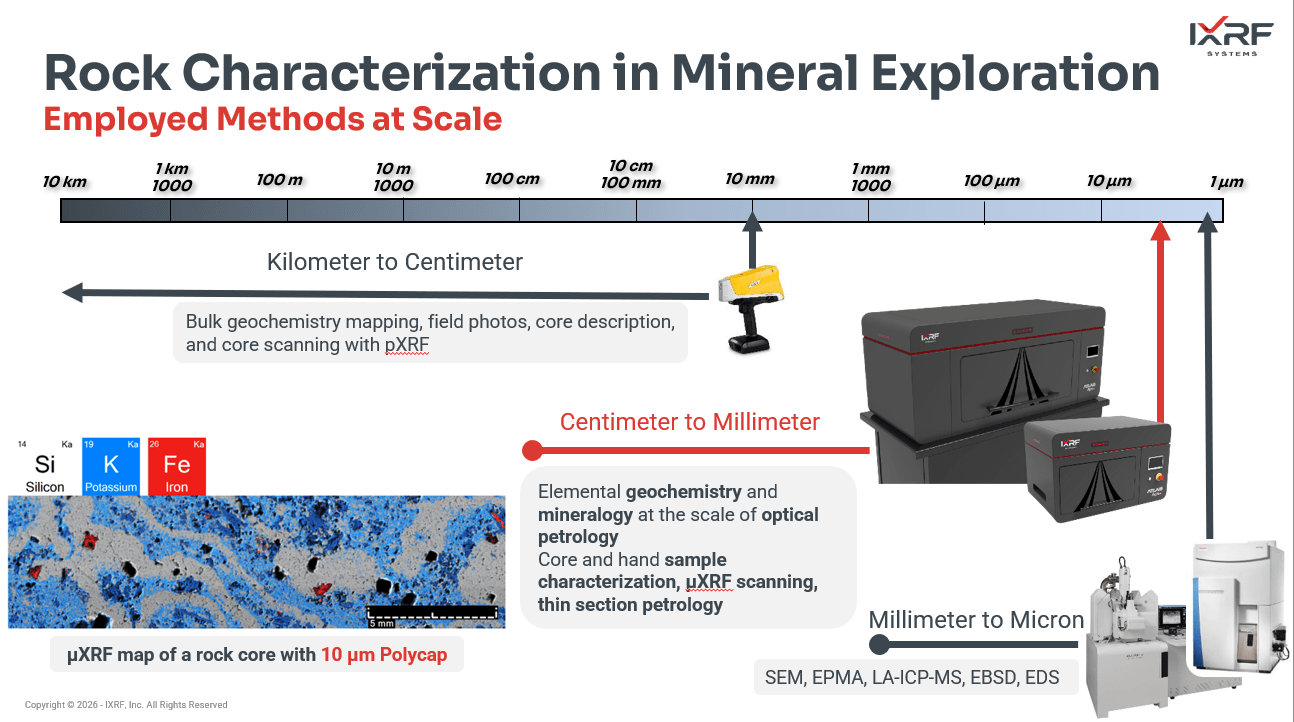
Figure 2. MicroXRF occupies the critical centimeter-to-millimeter analytical domain, bridging field-scale and micron-scale techniques.
The most sophisticated labs are not choosing between these tools. They are sequencing them. The new Atlas Apex microXRF becomes the analytical bridge between field-scale portable XRF and micron-scale electron microanalysis.
A Broader Elemental Envelope
Atlas Apex microXRF supports elemental detection from carbon through americium, providing flexibility across:
- Silicate petrology
- Sulfide systems
- Transition metal studies
- Rare earth element mapping
- Actinide research
Combined with configurable spot sizes, from tens of microns using polycapillary optics to larger collimated beams, microXRF enables tailored analytical strategies depending on the scientific question.
The Strategic Implication
Geoscience is increasingly data-driven. Interpretation depends on integrating chemical, structural, and spatial datasets across scales. MicroXRF expands the spatial and sensitivity envelope of what can be measured efficiently and non-destructively.
For laboratories focused on:
- Exploration targeting
- Mineral systems modeling
- Petrological zonation
- Trace element mapping
- High-throughput core analysis
MicroXRF is not an incremental upgrade. It is a structural enhancement to analytical capability.
The Bottom Line
SEM and EDS remain essential. But alone, they leave analytical blind spots, particularly at larger scales and lower concentrations. MicroXRF closes those gaps.
At IXRF Systems, we built the Atlas Apex platform to meet this strategic need: deeper sensitivity, larger mapping capability, minimal preparation, and workflow efficiency.
The labs that integrate microXRF thoughtfully are not abandoning electron microscopy. They are strengthening it. And in today’s competitive exploration and research environment, that integration is becoming less optional and more decisive.
See the Difference in Your Own Samples
The most compelling evidence is your own data. If you are evaluating:
- Large-area elemental mapping
- Trace element zonation below SEM detection limits
- Workflow efficiency improvements
- Complementary strategies for SEM, EPMA, or LA-ICP-MS
We invite you to request a sample analysis or schedule a live demonstration of the Atlas Apex microXRF system.
Send us one of your thin sections, core segments, or hand specimens. We will map it and show you what becomes visible when sensitivity and scale are no longer limiting factors.
To arrange a confidential sample evaluation or virtual demonstration, contact IXRF Systems today. Your geology deserves to be seen at the right scale.