

⚡TL; DR — In microXRF, “faster” only creates value if spectral integrity holds at elevated count rates. Many systems degrade as throughput rises—broadening peaks, increasing overlaps, and reducing counting statistics—creating hidden costs in rescans, delayed decisions, and underutilized instruments. Modern performance is defined by detector solid angle, scalable multi-detector architectures, and high-capacity electronics that sustain trustworthy data at practical mapping speeds across critical minerals, industrial QA/QC, light-element work, and high-resolution research.
Estimated read time: ~5–6 minutes.
In analytical science, faster is often assumed to be better. Shorter acquisition times promise higher throughput, quicker decisions, and increased productivity. However, in micro–X-ray fluorescence (microXRF), speed without control can quickly become a liability rather than an advantage.
As laboratories push instruments harder—using higher beam currents, shorter dwell times, and larger maps—many systems reach a point where data quality gradually declines. Peaks become broader, overlaps increase, counting statistics deteriorate, and the result is not faster insight but more rescans, longer analysis cycles, and reduced confidence in results.
The true differentiator in modern microXRF is no longer raw speed alone but the ability to maintain high data quality at practical measurement speeds.
The Hidden Cost of “Fast” Data
Most microXRF systems face a core limitation: as count rates go up, detector and electronics performance become the bottleneck. Eventually, increasing speed no longer yields more useful data—it produces distorted spectra and unreliable outcomes. From a business and research standpoint, this leads to three hidden costs:
- Rework – Analysts must repeat measurements or slow down to obtain usable data.
- Decision delays – Poor spectral quality extends interpretation time and increases uncertainty.
- Underused equipment – Instruments that could handle higher throughput in theory deliver less in practice.
In high-value analytical workflows, these costs often outweigh the apparent benefits of faster scans.
Why Detector and Electronics Architecture Matters
Sustained high-throughput performance is primarily a hardware and electronics issue, not a software one. Systems with:
- Limited detector solid angle
- Single-detector bottlenecks
- Low-capacity digital pulse processing
inevitably sacrifices speed for quality. In contrast, modern high-performance microXRF platforms are designed around three core principles:
- Scalable detector area to enhance true counting statistics
- High-capacity signal processing to manage increased event rates without spectral collapse
- User-controlled performance tuning to adjust speed and resolution based on the task
The new Atlas Apex from IXRF Systems is engineered around a high-throughput detector and electronics architecture that sustains clean, well-resolved spectra as count rates rise. Instead of “going faster” until peaks broaden, overlaps increase, and maps become unusable, Atlas Apex is designed to preserve spectral integrity at practical measurement speeds—delivering more usable data per hour with fewer rescans and greater confidence in the results.
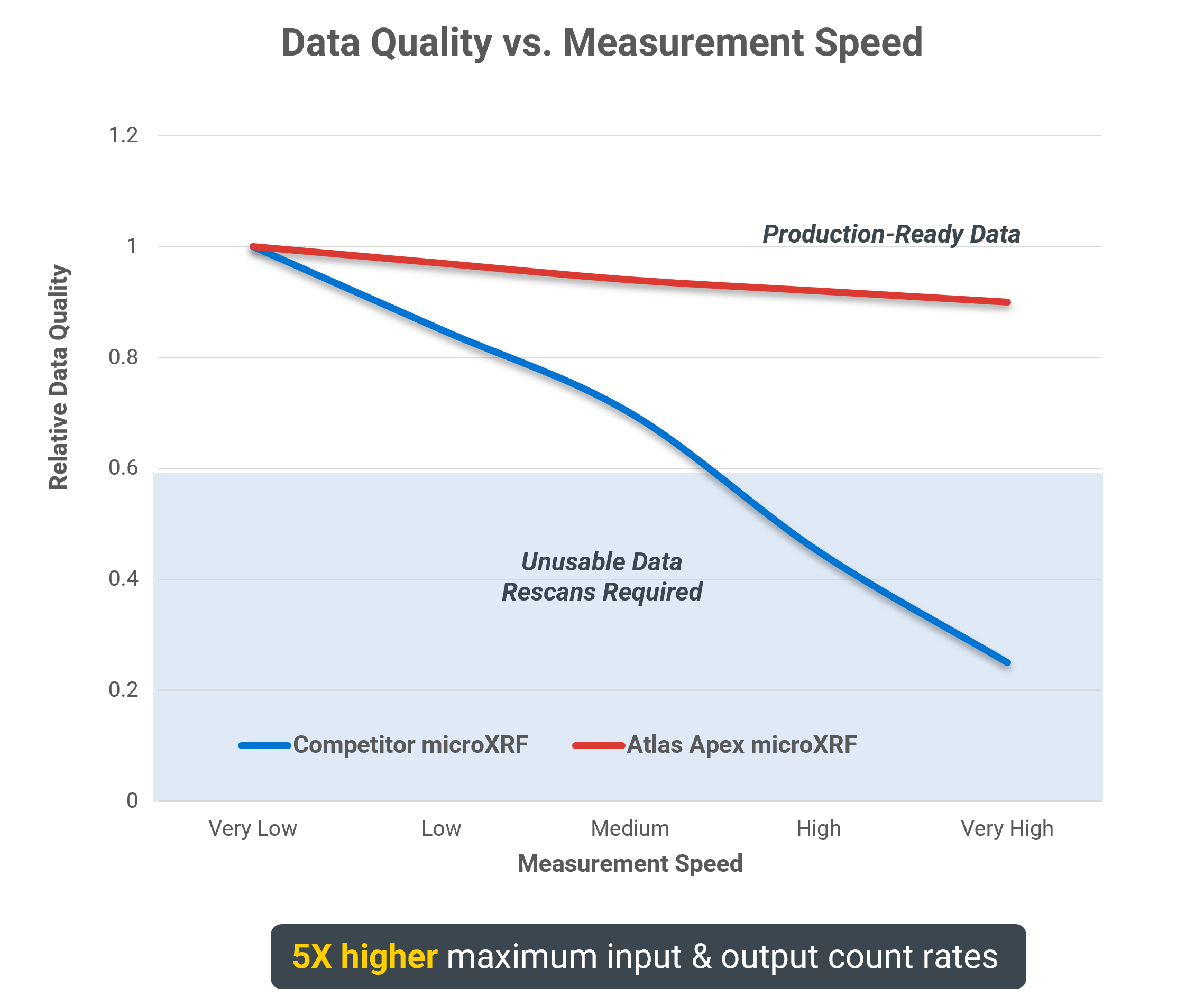
Figure 1. Data Quality vs. Measurement Speed (conceptual comparison).
Line chart illustrating how relative microXRF data quality changes as measurement speed increases from Very Low to Very High. The Atlas Apex microXRF (red curve) maintains near-constant, production-ready data quality across the full speed range, while a competitor microXRF (blue curve) shows a steep decline at higher speeds, crossing into a shaded “Unusable Data / Rescans Required” zone.
Where This Matters Most: Real-World Applications
The benefits of maintaining high data quality at high throughput are tangible—they directly influence outcomes across key application areas.
1. Critical Minerals and Geologic Mapping
In the exploration of critical minerals, large-area elemental maps are essential for understanding mineral relationships, zoning, and deportment. These datasets typically require a significant time investment.
High-throughput microXRF enables:
- Quicker coverage of large thin sections and drill cores
- Enhanced detection of trace phases without lengthy dwell times
- Increased confidence in elemental correlations at the microscale
The capability to produce clean spectra at increased mapping speeds leads to improved geological interpretation in less time.
Application Highlight: Critical Minerals & Rare Earth Element (REE) Exploration
Challenge:
Large-area mineral mapping needs high throughput, but increasing speed can compromise trace-element detection and phase relationships.
Importance: Missing trace phases or misrepresentation of elemental associations can lead to incorrect conclusions about ore-hosting and processing potential.
Atlas Apex Benefit: Maintains high-quality spectra at higher count rates, allowing for faster large-area mapping while preserving the spatial and compositional details essential for mineral deportment analysis.
Result: More accurate geological interpretations per thin section without extending the acquisition time.
2. Industrial QA/QC and Failure Analysis
In manufacturing settings—metals, electronics, aerospace—time is often the most limited resource. Here, sustained performance at speed allows for:
- Quick verification of alloy composition and coatings
- Reliable analysis across interfaces and diffusion zones
- Fewer inspection delays on valuable components
When data quality drops at high speed, QA workflows slow down. When it remains high, microXRF becomes a production-aligned tool, not just a lab instrument.
Application Highlight: Industrial QA/QC & Failure Analysis
Challenge:
Production and quality teams need quick answers, but poor data quality causes rescans, delays, and uncertainty.
Why It Matters:
In aerospace, electronics, and advanced manufacturing, inspection hold-ups directly affect cost, throughput, and risk.
Atlas Apex Advantage: Delivers production-ready data quality at higher speeds, enabling fast compositional checks across welds, coatings, and interfaces.
Outcome:
MicroXRF becomes a workflow enabler—not a bottleneck—supporting real production timelines.
3. Light-Element–Sensitive Materials Systems
Applications involving ceramics, glasses, cements, battery materials, and advanced composites increasingly rely on accurate detection of light elements.
Enhanced low-energy sensitivity enables:
- Improved characterization of elements such as F, Na, Mg, Al, and Si
- Lower detection limits without the need for extended acquisition times
- More dependable measurement of compositional gradients in heterogeneous materials
In these systems, throughput without sensitivity is meaningless—both must grow together.
Application Highlight: Light-Element-Sensitive Materials (Cements, Glasses, Batteries)
Challenge:
Light elements emit low-energy X-rays that are easily lost in inefficient detector designs, especially at high speeds.
Why it Matters:
Poor sensitivity to light elements can hide critical compositional gradients that influence material performance.
Atlas Apex Advantage: Customized detector windows and electronics improve transmission and sensitivity below 1 keV without requiring lengthy acquisition times.
Outcome:
More reliable light-element data with faster turnaround and increased confidence.
4. High-Resolution Elemental Mapping
As users demand higher spatial resolution, the challenge increases: smaller spots lower the signal, tempting users to push systems harder. Platforms that increase counting statistics using multiple detectors instead of brute force enable:
- High-resolution mapping with less noise
- Faster processing of large datasets
- More reliable quantitative results across maps
This is especially important in academic and national laboratory settings where data quality must pass peer review.
Application Callout: High-Resolution Elemental Mapping
Challenge:
As spot size decreases, the signal drops—leading users to push systems into regimes where spectral quality fails.
Why It Matters:
High-resolution maps are only useful if the data remains statistically sound and easy to interpret.
Atlas Apex Advantage: Multi-detector configurations that scale up true counting statistics, not just brute-force excitation.
Outcome:
Finer spatial detail, quicker map completion, and consistent quantitative performance.
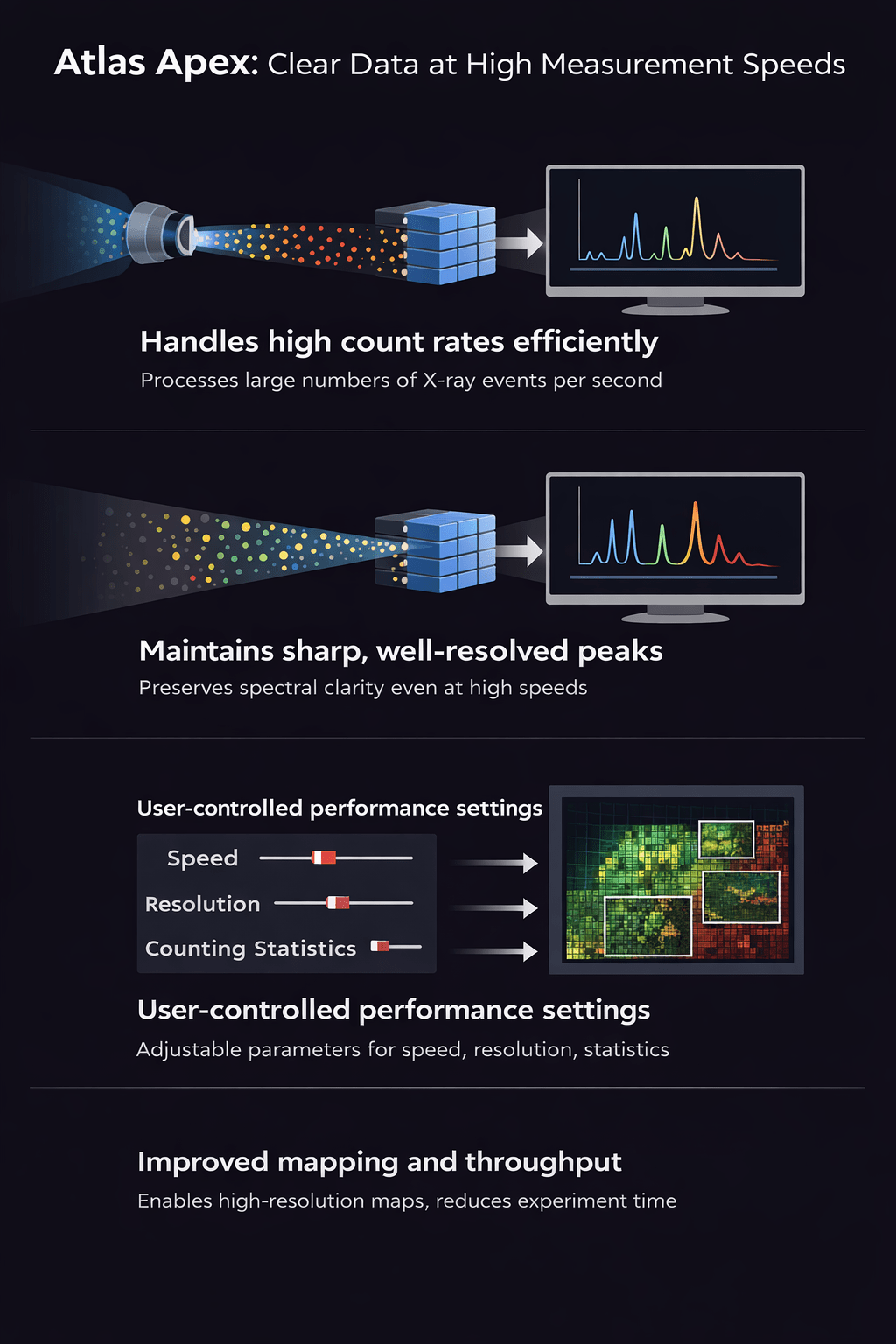
Figure 2. Atlas Apex: Clear Data at High Measurement Speeds (performance concept).
Infographic illustrating why Atlas Apex maintains spectral integrity at high throughput: it efficiently processes high X-ray event (count) rates, preserves sharp, well-resolved spectral peaks at faster acquisition settings, and provides user-controlled tuning of speed, resolution, and counting statistics to optimize mapping performance and reduce total experiment time.
A Strategic Shift in How Performance Is Defined
The most significant change in microXRF over the past decade isn’t just incremental resolution improvements—it’s a fundamental redefinition of performance itself.
Performance is no longer: “How fast can the system run?” It is: “How fast can the system run before the data stops being trustworthy?”
In that context, detector architecture, electronics capacity, and scalability are more important than headline specifications.
Application Callout: Academic & National Laboratory Research
Challenge:
Research datasets must pass peer review, meet reproducibility standards, and support long-term data reuse.
Why It Matters:
Speed without data integrity compromises publication quality and scientific credibility.
Atlas Apex Advantage:
User-controlled performance tuning lets researchers optimize experiments without entering data-quality failure regimes.
Outcome:
High-throughput experiments with defensible, publication-grade results.
Looking Forward
As analytical workloads keep increasing in size, complexity, and urgency, the instruments that will succeed are those built for consistent, real-world performance—not just maximum specs under perfect conditions.
For microXRF users, the competitive edge is found in systems that provide:
- More usable data per hour
- Fewer rescans
- Increased confidence in decisions
Speed still matters—but only when paired with control.
See what “high-throughput without spectral collapse” looks like on your samples. Request a live Atlas Apex demo, and we’ll run a representative map (or linescan), review spectra quality at practical count rates, and share the resulting data for your workflow evaluation.
IXRF Systems develops advanced X-ray fluorescence instrumentation that delivers high-quality data at real-world speeds across research and industrial applications.