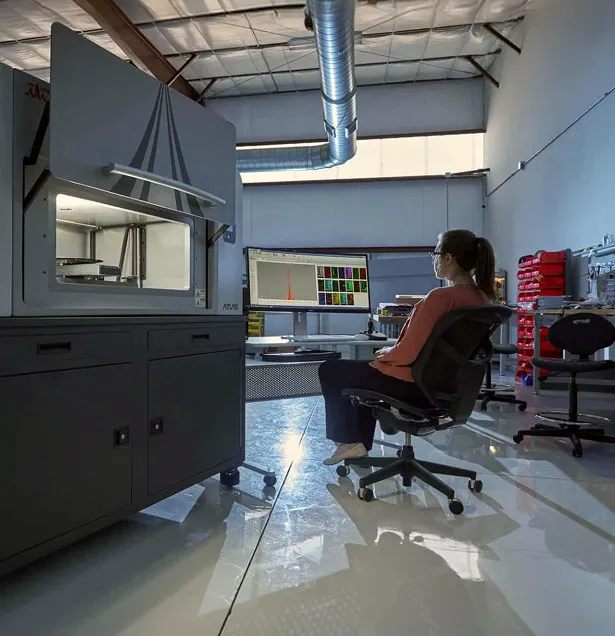
Element Identification and Concentration Measurement Answer Different Questions
MicroXRF can answer several different types of analytical questions.
Sometimes the objective is simply to determine which elements are present and where they occur. In other cases, researchers need to compare relative concentrations between regions. And in more demanding applications, the goal is to determine an actual elemental concentration.
These approaches are related, but they are not the same.
Understanding the difference between qualitative, semi-quantitative, and quantitative microXRF is essential for selecting the right analytical method and interpreting results correctly.
What Is Qualitative MicroXRF?
Qualitative microXRF answers the question: Which elements are present, and where are they located?
An XRF spectrum contains characteristic peaks corresponding to elements within the analyzed region. By identifying those peaks, users can determine which elements are present.
When spectra are collected across many positions, the resulting data can be displayed as elemental maps showing how those elements are distributed throughout the sample.
Qualitative analysis is particularly useful for:
- Locating specific elements
- Identifying inclusions or contaminants
- Comparing mineral phases
- Mapping coatings and interfaces
- Finding regions of interest
- Detecting compositional differences
- Investigating elemental associations
- Screening unknown materials
For many microXRF applications, this spatial information provides the most important analytical insight.
A geological researcher, for example, may be more interested in determining which mineral phase hosts a critical element than in determining the average concentration of that element across the entire specimen.
What Is Semi-Quantitative MicroXRF?
Semi-quantitative analysis moves beyond simple presence or absence by estimating relative or approximate elemental concentrations.
This approach may be useful when the primary objective is to compare regions within the same sample or identify meaningful compositional trends.
Examples include:
- Comparing metal concentrations between inclusions
- Evaluating compositional changes across a reaction front
- Comparing multiple mineral grains
- Screening samples before more rigorous quantitative analysis
- Identifying regions with elevated contaminant levels
Semi-quantitative results can provide valuable information without requiring the full calibration and sample preparation that may be necessary for high-accuracy quantitative measurements.
However, results should still be interpreted carefully because XRF intensity is affected by the surrounding material.
Why XRF Intensity Is Not the Same as Concentration
A brighter pixel on an elemental map does not automatically mean that the concentration is proportionally higher.
Measured XRF intensity can be influenced by:
- Matrix composition
- Sample density
- Sample thickness
- Surface topography
- Beam geometry
- X-ray absorption
- Secondary fluorescence
- Detector geometry
- Acquisition time
- Excitation conditions
This is why an intensity map should generally be interpreted as a representation of detected X-ray signal rather than a direct concentration map unless appropriate quantitative corrections have been applied.
What Is Quantitative MicroXRF?
Quantitative microXRF attempts to determine how much of an element is present.
Results may be expressed as:
- Weight percent
- Atomic percent
- Parts per million
- Concentration by area or region
Quantitative analysis requires a mathematical relationship between measured X-ray intensity and elemental concentration.
Depending on the application, this relationship may be established using calibration standards, fundamental-parameters calculations, or a combination of both.
Fundamental Parameters Quantification
Fundamental parameters, often abbreviated FP, use known physical relationships governing X-ray excitation, fluorescence, absorption, and detection to calculate elemental concentrations.
FP methods can reduce dependence on large sets of physical calibration standards, particularly when sample composition and geometry are reasonably well understood.
However, the accuracy of any quantitative method depends on how closely the analytical model represents the actual sample.
Irregular surfaces, unknown phases, heterogeneous materials, thin layers, and complex geometries can introduce uncertainty.
Matrix Effects
One of the most important concepts in quantitative XRF is the matrix effect.
Elements in a sample do not behave independently.
The surrounding matrix can absorb both the incident X-rays and the fluorescent X-rays generated within the sample. Other elements may also produce secondary excitation.
As a result, identical concentrations of an element can produce different measured intensities in different sample matrices.
Quantitative software must account for these effects if concentration values are to be reliable.
When Should You Use Qualitative Mapping?
Qualitative mapping is often the best approach when the primary objective is to understand spatial relationships.
Examples include:
- Locating rare mineral phases
- Identifying elemental zoning
- Mapping corrosion products
- Investigating contamination
- Finding inclusions
- Evaluating coatings
- Locating elements in biological tissues
- Examining pigments in artwork
In these applications, the location and association of elements may matter more than an absolute concentration value.
When Should You Use Quantitative Analysis?
Quantitative microXRF becomes important when the analytical question requires concentration data.
Examples include:
- Comparing alloy compositions
- Measuring elemental concentrations within phases
- Evaluating manufacturing specifications
- Characterizing coatings
- Comparing material batches
- Determining contaminant concentrations
- Supporting research requiring concentration values
The appropriate method depends on the required accuracy, sample condition, matrix, and available standards.
Qualitative and Quantitative Analysis Are Complementary
These approaches are not mutually exclusive.
A common microXRF workflow is:
- Collect an elemental map.
- Identify regions of interest.
- Examine spectra from those regions.
- Compare relative elemental intensities.
- Perform quantitative analysis where concentration values are required.
This combination preserves spatial context while concentrating quantitative effort on the regions that matter most.
Choosing the Right Analytical Approach
Before beginning an experiment, ask:
- Do I need to know what elements are present?
- Do I need to know where they are located?
- Do I need to compare regions?
- Do I need approximate concentrations?
- Do I need defensible quantitative values?
The answers determine whether qualitative, semi-quantitative, or quantitative microXRF is most appropriate.