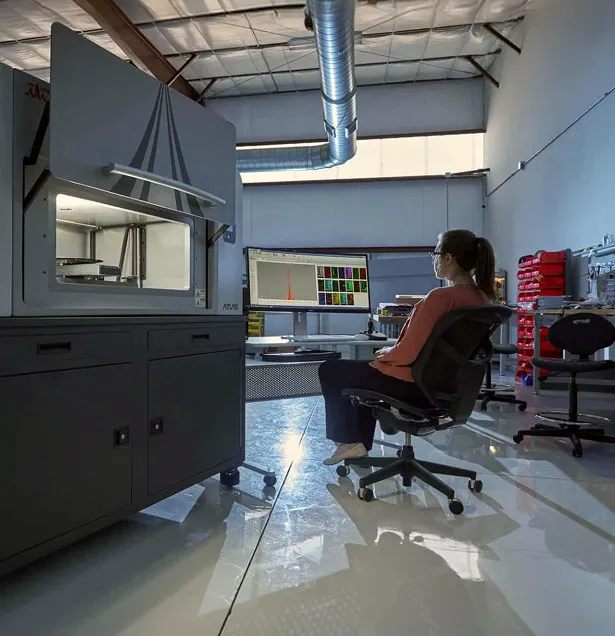
Building Better MicroXRF Workflows
Successful microXRF analysis begins before the first spectrum is collected.
The quality and usefulness of the final data depend on how the analytical question, sample preparation, instrument configuration, acquisition settings, and data-processing strategy work together.
An effective workflow connects each of these decisions.
Start With the Analytical Question
Before defining a map, determine what information is actually needed.
Examples might include:
- Where is a contaminant located?
- Which mineral hosts a critical element?
- How uniform is a coating?
- Are two regions compositionally different?
- Where does corrosion begin?
- How far has an element diffused across an interface?
- Are there hidden compositional features beneath a painted surface?
The answer determines how the measurement should be designed.
Step 1: Survey the Sample
Begin by examining the sample optically and understanding its geometry.
Identify:
- Regions of interest
- Surface irregularities
- Important boundaries
- Representative areas
- Potential contamination
- Features requiring higher spatial resolution
A large-area overview map can often reveal unexpected features that help guide subsequent measurements.
Step 2: Select the Appropriate Spatial Scale
Not every experiment requires the smallest possible pixel size.
If the feature of interest is several millimeters across, collecting millions of extremely small pixels may add acquisition time without producing useful additional information.
A common strategy is to begin with a broad survey and then collect higher-resolution maps from selected regions.
This multi-scale workflow allows researchers to preserve sample context while concentrating measurement time where it matters most.
Step 3: Select Acquisition Conditions
Important variables can include:
- X-ray source conditions
- Optic or beam configuration
- Pixel spacing
- Dwell time
- Number of detectors
- Acquisition atmosphere
- Scan area
These variables affect spatial resolution, sensitivity, counting statistics, and total acquisition time.
Optimizing a map therefore requires balancing analytical performance against experimental efficiency.
Step 4: Review Spectra During the Experiment
Elemental maps are only part of the dataset.
Reviewing spectra from representative locations can help confirm:
- Which elements are present
- Whether peaks are correctly assigned
- Whether additional elements should be mapped
- Whether acquisition time is sufficient
- Whether unexpected phases or contaminants are present
This feedback can be used to refine subsequent measurements.
Step 5: Analyze Regions of Interest
Once important features have been identified, targeted analysis can provide additional information.
Users may collect:
- Higher-resolution maps
- Point spectra
- Line scans
- Quantitative measurements
- Automated spectral spot analyses
This hierarchical approach can be more efficient than collecting maximum-resolution data across the entire specimen.
Step 6: Connect Chemistry With Structure
The most useful microXRF interpretation often comes from comparing elemental information with sample structure.
Depending on the application, users may combine XRF maps with:
- Optical images
- Petrographic observations
- SEM images
- XRD data
- CT images
- Raman measurements
- Mechanical testing
- Process history
This provides context that elemental maps alone cannot always supply.
Workflows by Application
Different materials require different strategies.
Explore dedicated workflows for:
- Geology and mining
- Critical minerals
- Battery and energy materials
- Semiconductors and microelectronics
- Materials science
- Environmental and life science research
- Art and archaeology
- Industrial quality and failure analysis
Each workflow addresses the practical decisions that affect data quality, efficiency, and interpretation.
From Sample to Answer
MicroXRF is most powerful when it is treated as an analytical workflow rather than simply an instrument measurement.
By matching spatial scale, acquisition conditions, and analysis strategy to the scientific question, laboratories can collect more meaningful data while avoiding unnecessary measurement time.